POLIGOV Ethics, Funding and Generative AI Policy
POLIGOV: Malaysian Journal of Policy, Leadership, International & Government Affairs is committed to maintaining high standards of research integrity, transparency, ethical conduct, and responsible use of emerging technologies.
All authors are required to comply with the following policies when preparing and submitting manuscripts.
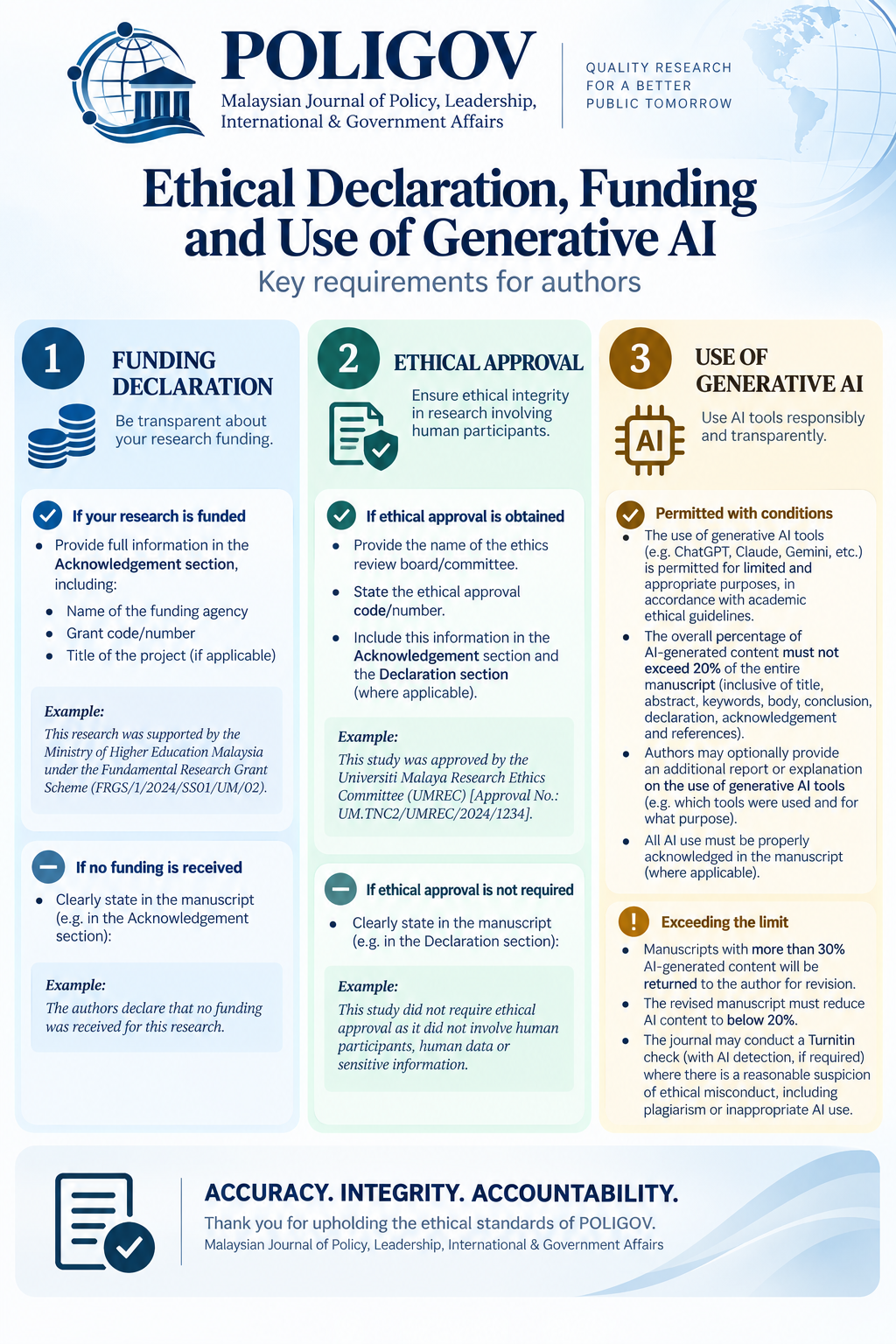
1. Funding DeclarationAuthors must clearly disclose whether the research received financial support from any grant, institution, agency, organisation, or funding body.
Where funding has been received, the manuscript should provide:
- the name of the funding agency or organisation;
- the grant code or reference number;
- the title of the funded project, where applicable; and
- any other relevant funding information required by the funding body.
This information should be stated clearly in the Acknowledgement and/or Declaration section of the manuscript.
An appropriate statement may take the following form:
This research was supported by [Funding Agency] under Grant No. [Grant Code/Number].
Where the research did not receive any external funding, authors should state this clearly.
For example:
The authors declare that no external funding was received for this research.
2. Ethical ApprovalResearch involving human participants, respondents, interviews, focus groups, surveys, personal data, sensitive information, or other activities requiring ethical clearance must comply with appropriate institutional and disciplinary ethical standards.
Where ethical approval has been obtained, authors must provide:
- the name of the ethics review board, institutional review board, or ethics committee;
- the ethical approval code or reference number; and
- any other relevant approval information.
This information should be included in the relevant Acknowledgement and/or Declaration section of the manuscript.
For example:
This study received ethical approval from [Name of Ethics Committee], Approval No. [Reference Number].
Authors must also ensure that participants or respondents are appropriately anonymised where required and cannot be identified from the published manuscript unless explicit and ethically appropriate consent has been obtained.
Where a study does not require formal ethical approval, authors may state this clearly, where appropriate.
For example:
This study did not require formal ethical approval as it did not involve human participants, identifiable personal data, or sensitive information.
3. Responsible Use of Generative AIPOLIGOV permits the use of generative AI tools only where such use is limited, appropriate, transparent, and consistent with academic integrity requirements.
Authors remain fully responsible for the accuracy, originality, citations, references, arguments, analysis, and overall integrity of the manuscript.
Generative AI tools must not be listed as authors.
Where generative AI has been used, authors should disclose its use where applicable. Authors may also provide an optional supplementary statement or report describing:
- the AI tool used;
- the purpose for which it was used;
- the sections or tasks for which it was used; and
- how the authors checked and verified the generated material.
As an internal editorial guideline, the proportion of AI-generated content in a submitted manuscript should normally not exceed 20% of the entire manuscript. The assessment applies to the manuscript as a whole, including:
- title;
- abstract;
- keywords;
- main body;
- conclusion;
- figures, tables, illustrations and diagrams;
- declarations;
- acknowledgements; and
- reference-related text where applicable.
Where the editorial assessment identifies AI-generated content of more than 25%, the manuscript may be returned to the author for revision before further editorial processing. The author will normally be required to revise the manuscript so that the assessed level of AI-generated content is reduced to below 20%.
5. Academic Integrity and PlagiarismThe use of generative AI does not exempt authors from standard academic integrity requirements. Authors must ensure that the manuscript:
- does not contain plagiarism;
- does not fabricate or falsify information;
- does not include invented or unverifiable citations;
- accurately represents sources and evidence;
- does not misrepresent AI-generated material as independent scholarly evidence; and
- complies with recognised academic and publication ethics.
The POLIGOV Editorial Board reserves the right to conduct additional integrity checks where there is a reasonable basis to do so. These checks may include:
- plagiarism screening;
- Turnitin similarity checking;
- review of citation accuracy;
- verification of declarations;
- review of ethical approval information; and
- assessment of the possible extent of generative AI use.
Additional checks may be undertaken where there is reasonable concern about potential academic misconduct, inappropriate AI use, plagiarism, fabrication, or other breaches of research integrity.
7. Author ResponsibilityThe corresponding author and all co-authors are collectively responsible for ensuring that all declarations made during submission are accurate and complete. By submitting a manuscript to POLIGOV, authors confirm that:
- all funding sources have been properly disclosed;
- relevant ethical approval has been obtained and reported where required;
- participant confidentiality and anonymity have been protected;
- any use of generative AI has been responsible and appropriately disclosed;
- the manuscript does not breach academic integrity standards; and
- all authors accept responsibility for the final submitted work.
Failure to provide accurate funding, ethical, or AI-use declarations may result in the manuscript being returned for correction, delayed in editorial processing, rejected, or referred for further editorial review where necessary.
POLIGOV expects all authors to uphold transparency, research integrity, ethical responsibility, and accountability throughout the publication process.