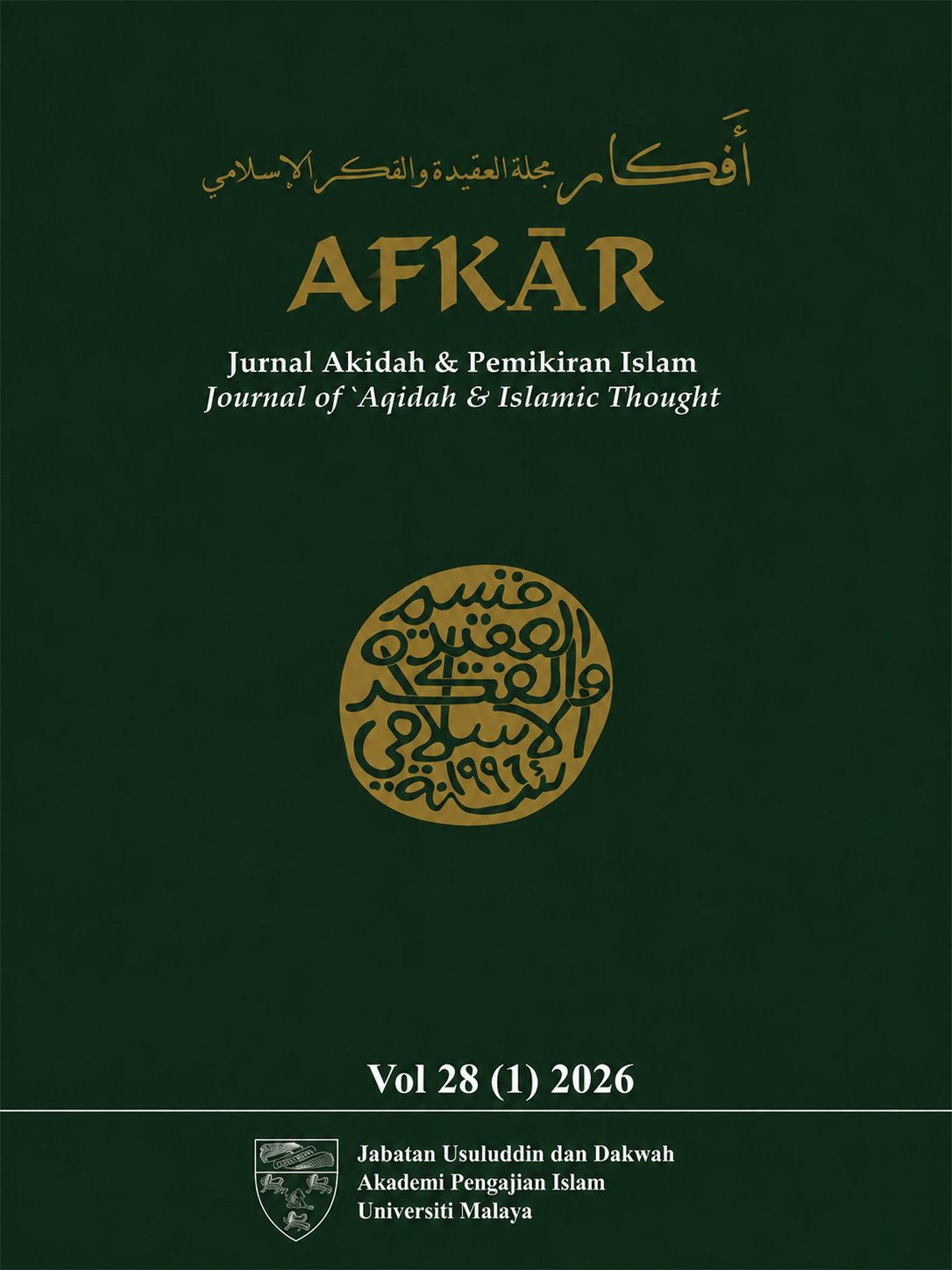
Exploring Bediuzzaman Said Nursi’s Thought on Nature from the Perspective of Kalām Jadīd
DOI:
https://doi.org/10.22452/afkar.vol28no1.2Keywords:
Said Nursi, Kalām jadīd (new theology), al-ma‘nā al-ismī, al-ma‘nā al-ḥarfī, environmental ethics.Abstract
This study examines Said Nursi’s interpretation of nature within the framework of Kalām Jadīd (Neo Kalam) as a response to modern secular understandings of the natural world. Modern scientific discourse has often been shaped by philosophical currents such as naturalism, scientism, and materialism, which interpret nature as an autonomous system governed solely by causal laws without reference to divine agency. From the perspective of Islamic theology, such interpretations raise fundamental questions about the relationship between God and the natural order. Using qualitative textual analysis, primarily based on Nursi’s Risale-i Nur, this study explores how Nursi reconstructs the concept of nature through the epistemological distinction between al-ma‘nā al-ismī (the nominal meaning) and al-ma‘nā al-ḥarfī (the indicative/relational meaning). The findings show that the ismī perspective represents a secular mode of perception that treats nature as a self-sufficient material reality explained through causation, natural laws, and chance. In contrast, the harfī perspective understands nature as a network of signs (āyāt) that reflect divine attributes and point to the existence of the Creator. Within this framework, causal relations function not as independent creative powers but as patterns through which divine wisdom becomes manifest. This perspective also has environmental implications, encouraging a responsible and ethical relationship between humans and nature.
References
Aidus, D. “The Approach to the Environment Question of the Qur’an and Its Contemporary Commentary, The Risale-i Nur.” (Paper, The Fourth International Symposium on Bediuzzaman Badiuzzaman Sa’id Nursi: A Contemporary Approach Toward Understanding the Qur’an: The Example of Risale-I Nur. Istanbul, 1998).
Acikgenc, Alparslan. "Causation in Islamic Philosophy". In Encyclopedia of Philosophy. New York: Palgrave Macmillan, 2006.
Akyesilmen, Nezir, and Ozcan, Arif Behic. “Islamic Movements and Their Role In Politics In Turkey.” Selcuk University Journal of Institute of Social Sciences 31 (2014): 29–38. https://izlik.org/JA49PD44NW.
Al-Attas, Syed Muhammad Naquib. Islam dan Filsafat Sains. Bandung: Institut Pemikiran Islam dan Pembangunan Insan, 2010.
Al-Attas, Syed Muhammad Naquib. Prolegomena to the Metaphysics of Islam: An Exposition of the Fundamental Elements of the Worldview of Islam. Kuala Lumpur: International Institute of Islamic Thought and Civilization (ISTAC), 1995.
Al-Ghazali. The Incoherence of the Philosophers (Tahāfut Al-Falāsifah): A Parallel English-Arabic Text, ed. M. E. Marmura. Provo: Brigham Young University Press, 2000.
Al-Hind, Shiblī al-Nu‘mānī, ‘Ilm Kalām Jadīd. Cairo: Al-Markaz al-Qawmī li al-Tarjamah, 2012.
Ali, Muhamed and Agushi, Muaz. Eco-Islam: Integrating Islamic Ethics into Environmental Policy for Sustainable Living. International Journal of Religion 5(9) (2024), 949–950: https://doi.org/10.61707/gq0we205
Al-Ṣāliḥi, Iḥsān Qāsim. Badīʿ al-Zamān Saʿīd al-Nursī: Naẓrah ʿĀmmah ʿan Ḥayātih wa Āthārih. Morocco: Maṭbaʿat al-Najāḥ al-Jadīdah, 1999.
Altmeyer, Stefan. “Religious Education for Ecological Sustainability: An Initial Reality Check Using the Example of Everyday Decision-Making.” Journal of Religious Education 69(1) (2021): 57–74. https://doi.org/10.1007/s40839-020-00131-5.
Aydin, Necati. Said Nursi and Science in Islam: Character Building through Nursi’s Mana-i Harfi. New York: Routledge, 2019. https://doi.org/10.4324/9780429019364.
Berger, Peter L. The Sacred Canopy: Elements of a Sociological Theory of Religion. New York: Doubleday & Company, 1969.
Cresswell, John W. Research Design, Qualitative, Quantitative and Mixed Method Approaches, ed. Achmad Fawaid. Yogyakarta: Pustaka Pelajar, 2014.
Cox, Harvey. The Secular City. New York: MacMillan Company, 1965.
Daud, Wan Mohammad Nor Wan. Filsafat Dan Praktik Pendidikan Islam Syed M. Naquib Al-Attas. Bandung: Mizan, 2003.
Denny, Frederick Mathewson. “Islamic Theology in the New World: Some Issues and Prospects.” Journal of the American Academy of Religion 64(4) (1994): 1069–1084. http://www.jstor.org/stable/1465233.
Droz, Layna. “Anthropocentrism as the Scapegoat of the Environmental Crisis: A Review.” Ethics in Science and Environmental Politics 22 (2022): 25–49. https://doi.org/10.3354/esep00200.
El Shirazy, Habiburrahman. Api Tauhid: Cahaya Keagungan Cinta Sang Mujaddid. Jakarta: Republika, 2014.
Fairclough, Norman. Critical Discourse Analysis: The Critical Study of Language. London and New York: Longman, 1995.
Fathullah Zarkasyi, Amal, and Mujahidin Akhmad. “A New ‘Ilm Kalam: Thinking Between the Classical Heritage and the Philosophical Methodology.” In Proceedings of the 1st International Conference on Social Sciences and Interdisciplinary Studies (ICSSIS 2018), 208:10–16. Paris, France: Atlantis Press, 2019. https://doi.org/10.2991/icssis-18.2019.3.
Fazlhashemi, Mohammad. “Islamic Ecotheology.” In Intersections of Religion, Education, and a Sustainable World, ed. Windsor, S., Franck, O., 25–40. Cham: Springer Nature Switzerland, 2025. https://doi.org/10.1007/978-3-031-81809-7_3.
Hamid, Zal Al. “Ekoteologi Dalam Islam Pandangan Said Nursi.” Relinesia: Jurnal Kajian Agama Dan Multikulturalisme Indonesia 3(3) (2024): 236–245.
Hasan, Nur. “Kritik Islamic Worldview Syed Muhammad Naquib Al-Attas Terhadap Western Worldview.” Maraji` Journal of Islamic Studies 1(1) (2014): 115-145.
Hasib, Kholili, and Abidin, Abidin. “The Concept of Nature According to Syed M Naquib Al-Attās: The Perspective of New Kalam.” Potret Pemikiran 27(1) (2023): 113. https://doi.org/10.30984/pp.v27i1.2551.
Hassan, M. Kamal. “The Necessity of Studying the Natural Sciences from the Qur’anic Worldview.” In Islamic Perspectives on Science and Technology, 35–56. Singapore: Springer Singapore, 2016. https://doi.org/10.1007/978-981-287-778-9_4.
Ibn Khaldūn. Al-Muqaddimah. Al-Muqaddimah. Morocco: Bayt al-Funūn wa al-‘Ulūm wa al-Adab, 2006.
Ihsan, Nur Hadi, and Mudin, Moh. Isom. “Paradigma Kalam Dalam Konservasi Lingkungan Menurut Said Nursi.” Tasfiyah 4(1) (2020): 27. https://doi.org/10.21111/tasfiyah.v4i1.4052.
Keskin, Zuleyha, and Mehmet Ozalp. “An Islamic Approach to Environmental Protection and Ecologically Sustainable Peace in the Age of the Anthropocene.” In Towards a Just and Ecologically Sustainable Peace, ed. Camilleri, J., Guess, D., 119–34. Singapore: Palgrave Macmillan, 2020. https://doi.org/10.1007/978-981-15-5021-8_6.
Khamami, Akhmad Rizqon. “Membangun Peradaban Dengan Epistemologi Baru: Membaca Pemikiran Said Nursi.” Tsaqafah: Jurnal Peradaban Islam 11(1) (2015): 51-70. https://doi.org/10.21111/tsaqafah.v11i1.253.
Luque-Moya, Gloria. “Toward a Harmonic Relationship between Humans and Nature.” Asian Studies 11(3) (2023): 129–47. https://doi.org/10.4312/as.2023.11.3.129-147.
Masykur, Zein Muchamad. “The Unity of Existence: Al-Bustami’s Sufism and Environmental Thought.” Renai 11(1) (2025): 56–69. https://renai-journal.percik.or.id/index.php/renai/article/view/24.
Masykur, Zein Muchamad, and Nasrudin. “Embracing the Sacred Trust: Said Nursi’s Sufism as a Pathway to Climate Resilience and Environmental Stewardship.” Asian Journal of Philosophy and Religion 3(2) (2024): 79–96. https://doi.org/10.55927/ajpr.v3i2.11861.
Mohd Dom, Adi Setia. Reviving Kalam Jadid in the Modern Age: The Perpetual Relevance of al-Ghazali and Fakhr al-Din al-Razi. Tafhim 4 (2011): 124–125.
Mudin, Moh Isom, Hamid Fahmy Zarkasyi, and Abdul Kadir Riyadi. “Prinsip Ekologis Untuk Kehidupan Berkelanjutan Perspektif Teologi Islam: Kajian Atas Kitab Rasail Al-Nur Sa’id Nursi.” Fikrah 9(1) (2021): 45. https://doi.org/10.21043/fikrah.v9i1.9018.
Nasr, Seyyed Hossein. Man and Nature: The Spiritual Crisis in Modern Man. London: Unwin Paperbacks, 1990.
Nasr, Seyyed Hossein. Religion and the Order of Nature. London: Oxford University Press, 1996.
Neuendorf, Kimberly A. The Content Analysis Guidebook. California: SAGE Publications, Inc. 2017. https://doi.org/10.4135/9781071802878.
Nursī, Badi'uzzamān Sa‘īd. Al-Mathnawī al-ʿArabī al-Nūrī. Cairo: Sozler Publications, 2004.
Nursi, Badiuzzaman Said. Signs of Miraculousness. Istanbul: Sozler, 1994.
Nursi, Badiuzzaman Said. Staff of Moses. Cairo: Sozler Publications, 2004.
Nursi, Badiuzzaman Said. The Flashes. Istanbul: Nesil, 2004.
Nursi, Badiuzzaman Said. The Rays. Istanbul: Nesil, 2004.
Nursi, Badiuzzaman Said. The Words. Istanbul: Nesil, 2005.
Onkal, Guncel. “Reconsidering the Paradigm Shift from Environmental Philosophy to Global Environmentalisms.” Filozofia 79(9) (2024): 1049–57. https://doi.org/10.31577/filozofia.2024.79.9.7.
Peels, Rik. “Scientism and Scientific Fundamentalism: What Science Can Learn from Mainstream Religion.” Interdisciplinary Science Reviews 48(2) (2023): 395–410. https://doi.org/10.1080/03080188.2022.2152246.
Prayogo, Tonny Ilham, and Rahmat, Abdul. “Ateisme Dalam Perspektif Barat Dan Timur.” Kalimah: Jurnal Studi Agama Dan Pemikiran Islam 17(1) (2019): 105. https://doi.org/10.21111/klm.v17i1.2943.
Rahardjo, Mudjia. Tanya Jawab Metodologi Penelitian Sosial Kualitatif, ed. Suprapto and Bresca Meirina. Mojokerto: Giri Prapanca Loka, 2024.
Richardson, Kara. “Causation in Arabic and Islamic Thought,” The Stanford Encyclopedia of Philosophy, ed. Edward N. Zalta, 3–6. 2015. https://plato.stanford.edu/entries/arabic-islamic-causation/.
Rofi’i, Muhammad Arwani, Zahroh, Siti Fatimatuz, and Tolipov, Nodir. “Critique of Materialism in ‘Ilm Al-Kalām Al-Jadīd: An Analysis of Jamaluddin Al-Afghani’s Thought.” Journal of Islamic and Occidental Studies 3(2) (2025): 212–37. https://doi.org/10.21111/jios.v3i2.80.
Rudert, Angela. “A Sufi, Sikh, Buddhist, TV Guru.” In Religious Pluralism, State and Society in Asia, ed. Chiara Formichi. New York & London: Routledge, 2014.
Safdar, Saad Saood, and Shams-ur-Rehmam, Ghulam. “The Roots of the Ecological Crisis in the Theological and Philosophical Landscape of Modern Civilization.” Islamic Studies 60(3) (2021): 287–308. https://doi.org/10.52541/isiri.v60i3.1847.
Saleh, Sujiat Zubaidi. The Epistemology of Contemporary Tafsir with Reference to Risale-I Nur Bediuzzaman Said Nursi. Yogyakarta: Kurnia Kalam Semesta, 2019.
Ṣalibā, J. Tārīkh al-Falsafah al-ʿArabiyyah. Beirut: Dār al-Kitāb al-Ranānī, 1970.
Salih, Ihsan Kasim. Said Nursi Pemikir Dan Sufi Besar Abad 20; Membebaskan Agama Dari Dogmatisme Dan Sekularisme Said Nursi. Jakarta: Murai Kencana, 2003.
Saputra, Gigih. “Zakir Naik’s Concept of Divinity-Cosmology: Criticism-Reconstruction of the Modern Natural-Cosmological Theology.” Teosofi: Jurnal Tasawuf dan Pemikiran Islam 10(2) (2020): 325–52. https://doi.org/10.15642/teosofi.2020.10.2.325-352.
Sempo, Muhammad Widus, and Khosim, Norullisza. “Said Nursi’s Thoughts on Environmental Sustainability in Risale-I Nur.” Afkar: Jurnal Akidah & Pemikiran Islam Special Issue 2 (2020): 107–32. https://doi.org/10.22452/afkar.sp2020no2.4.
Taufikin, Taufikin. “Integrating Eco-Theology in Islamic Education: A Case Study on Fostering Ecological Awareness Through Religious Pedagogy.” El-Tarbawi 18(1) (2025): 1–37. https://doi.org/10.20885/tarbawi.vol18.iss1.art1.
Turner, Colin. The Qur’an Revealed: A Critical Analysis of Said Nursi’s Epistles of Light. Berlin: Gerlach Press, 2013. https://doi.org/10.2307/j.ctt1df4hrm.
Vahide, Sukran. Biografi Intelektual Bediuzzaman Said Nursi: Transformasi Dinasti Usmani Menjadi Republik Turki. Jakarta: Anatolia, 2007.
Weber, Max. The Protestant Ethic and the Spirit of Capitalism, ed. T. Parsons. London & New York: Routledge Classics, 2001.
Weber, Max. The Sociology of Religion. Boston: Beacon Press, 1993.
Windham-Hughes, Colleen. “Relational and Procedural Literacies in the Study of Religion.” In Civility, Religious Pluralism and Education, ed. Vincent Biondo and Andrew Fiala. New York & London: Routledge, 2014.
Zarkasyi, Amal Fathullah, and Chandra Dwisetyo Widodo. “Said Nursi’s Concept of God and Nature: A Critique of the Views of Atheism and Naturalism.” Rusydiah: Jurnal Pemikiran Islam 4(2) (2023): 170–93. https://doi.org/https://doi.org/10.35961/rsd.v4i2.1077.
Downloads
Published
Issue
Section
License
Copyright (c) 2026 Afkar: Jurnal Akidah dan Pemikiran Islam

This work is licensed under a Creative Commons Attribution-NonCommercial 4.0 International License.