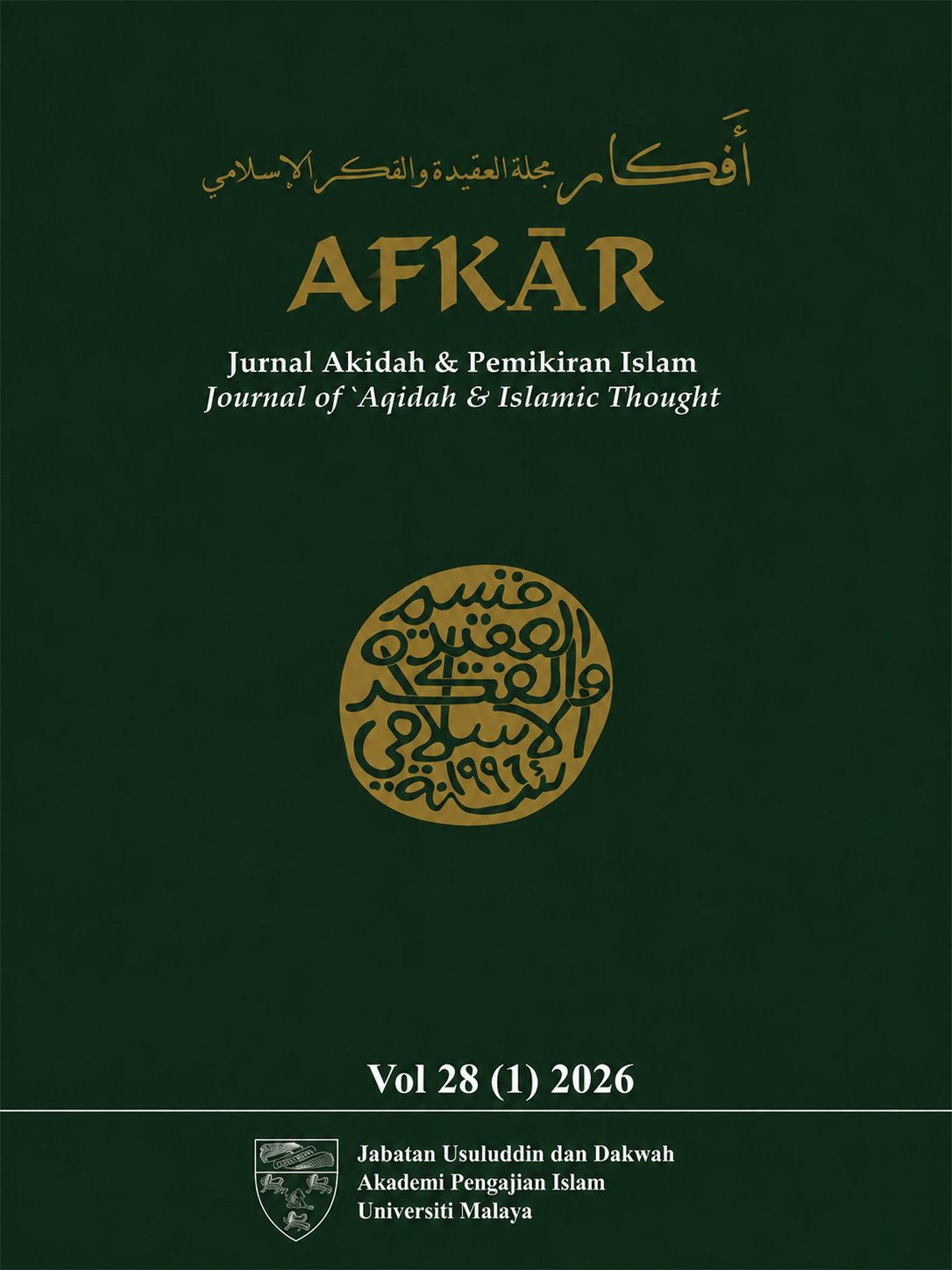
The Conflict Between Reason and Revelation in al-Ghazali’s Tahāfut al-Falāsifah: A Critical Study of Intellectual Sources
DOI:
https://doi.org/10.22452/afkar.vol28no1.11Keywords:
Al-Ghazali, Tahafut al-Falasifah, Islamic philosophy, reason and revelation, epistemologyAbstract
This study offers a critical reappraisal of Abu Hamid al-Ghazali’s Tahāfut al-Falāsifah, challenging the common view that he rejected philosophy entirely. By closely reading the text using both the approved English translation and the original Arabic and situating it within Ash‘arite theology and Avicennan metaphysics, the study highlights al-Ghazali’s nuanced and strategic engagement with philosophy. Rather than a blanket rejection of reason, Tahāfut al-Falāsifah presents a selective critique of metaphysical claims that, in al-Ghazali’s view, exceed the limits of reason and conflict with revelation. The analysis explores key themes such as al-Ghazali’s affirmation of divine will over necessity, his use of logic in defending theology, and his integration of Sufi concepts such as kashf and dhawq to expose the limits of discursive reasoning. It shows how he classifies philosophical doctrines as acceptable, irrelevant, or heretical, positioning revelation as the ultimate guide to truth. The study also reflects on the contemporary relevance of al-Ghazali’s thought for debates on metaphysics and the harmony of intellectual and spiritual knowledge. Moreover, this work reframes Tahāfut al-Falāsifah as a constructive synthesis of philosophy and theology, affirming its place as a landmark in Islamic intellectual history and as a model of bounded rationality that continues to resonate today.
References
Al-Ghazali, Abu Hamid Muhammed. The Incoherence of the Philosophers, trans. Michael E. Marmura. Provo, UT: Brigham Young University Press, 2000.
Alsuhaymi, Adeeb Obaid & Fouad, Ahmed Atallah. “Reason and Revelation in Ibn Taymiyyah’s Critique of Philosophical Theology: A Contribution to Contemporary Islamic Philosophy of Religion.” Religions 16(7) (2025): 809. https://doi.org/10.3390/rel16070809
Budi, Syihabuddin & Hasyim, Sumanta. “Al-Ghazali’s Empirical-Rational-Spiritual Epistemology and Its Implications for Contemporary Islamic Religious Education.” Afaqulilmi: Journal of Islamic Education 1(1) (2026): 83-99.
Bhat, Ali Muhammad & Afroz Ahmad, Bisati. “Rationality in the Qur’an: Integrating Reason and Revelation for Contemporary Islamic Education.” Dirasah International Journal of Islamic Studies 3(1) (2025): 1-17. https://doi.org/10.59373/drs.v3i1.40
Erdoğan, İbrahim Halil, and Sema Eryücel. “The concept of divine revelation according to Ibn sînâ and Al-Ghazālī: a comparative analysis.” Religions 15(11) (2024): 1383. https://doi.org/10.3390/rel15111383
Fakhry, Majid. Ethical Theories in Islam. Leiden: Brill, 2015.
Fathurrohman, Rizal, Abdul Munip & Muh Wasith Achadi. “The Epistemology of Riyāḍah in Pesantren: A Philosophical Foundation for Islamic Intellectual Formation.” Scaffolding Jurnal Pendidikan Islam Dan Multikulturalisme 7(3) (2025): 301-320. https://doi.org/10.37680/scaffolding.v7i3.7982
Ghossein, Mohamad. “Reason and Revelation in Islamic Political Theology: The Epistemological Foundations of Al-Ghāzālī’s Theocracy” (PhD Thesis, Université d’Ottawa/University of Ottawa, 2021.
Goodman, Lenn E. Islamic Humanism. Oxford: Oxford University Press, 2005.
Griffel, Frank. Al-Ghazali’s Philosophical Theology. Oxford: Oxford University Press, 2009.
Janssens, Jules. “Al-Ghazālī Between Philosophy (Falsafa) and Sufism (Taṣawwuf): His Complex Attitude in the Marvels of the Heart (‘Ajā’ib al-Qalb) of the Iḥyā’ ‘Ulūm al-Dīn." Muslim World 101(4) (2011): 614-632. https://doi.org/10.1111/j.1478-1913.2011.01375.x
Maghribi, Hamdan & Hidayah, Alfina. “Reason, Revelation, and Sufism: The Epistemic Paradigm of al-Ghazali and Ibnu Taimiyyah.” Journal of Islamic and Occidental Studies 3(2) (2005): 171-188. https://doi.org/10.21111/jios.v3i2.79
Makrifat, Makrifat, Santalia, Indo, Aderus, Andi & Kurniati, Yessy. “Reason and Revelation in Islamic Epistemology: A Hierarchical–Integrative Reconstruction.” Fitua: Jurnal Studi Islam 7(1) (2026): 35-48. https://doi.org/10.47625/fitua.v7i1.1213
Moad, Edward Omar. “Al-Ghazali’s Position on the ‘Second Proof’of the ‘Philosophers’ for the Eternity of the World, in the First Discussion of the Incoherence of the Philosophers.” Sophia 54(4) (2015): 429-441. https://doi.org/10.1007/s11841-014-0458-5
Mujahidin, Sultan. “The Supremacy of Revelation over Reason: Al-Ghazali’s Critique of Rationalist Philosophy in Tahāfut al-Falāsifah.” Islamic Thought Review 2(2) (2024): 151-162.
Namazi, Rasoul. “The Qur’an, Reason, and Revelation: Islamic Revelation and Its Relationship with Reason and Philosophy.” Interpretation: A Journal of Political Philosophy 43(3) (2017): 403-430.
Nasr, Seyyed Hossein. “Time and Eternity.” In The Essential Seyyed Hossein Nasr, ed. William C. Chittick. Foreword by Huston Smith. 159-169. Bloomington, IN: World Wisdom, 2007.
Nurhuda, Abid & Nawawi, Abdul Muid. “Tahafut al-Falasifah as a Critique of Paradigms: A Philosophical Analysis from the Perspective of Modern Science.” Anjasmoro: Islamic Interdisciplinary Journal 3(1) (2025): 22-35. https://doi.org/10.69965/anjasmoro.v3i1.201
Poya, Aminullah & Rizapoor, Habiburrahman. “Al-Ghazali’s Theory of Real Knowledge: An Exploration of Knowledge Integration in Islamic Epistemology through Contemporary Perspectives.” International Journal of Humanities Education and Social Sciences (IJHESS) 3(2) (2023): 607-624. https://doi.org/10.55227/ijhess.v3i2.627
Richard M., Frank. Al-Ghazālī and the Ashʻarite School. Durham: Duke University Press, 1994.
Shah, R. Rania. Al-Ghazālī on Reason and Revelation: A Revival in the Heart of the Islamic Scholarly Tradition. California: Graduate Theological Union, 2016.
Shihadeh, Ayman. “From al-Ghazālī to al-Rāzī: 6th/12th Century Developments in Muslim Philosophical Theology.” Arabic Sciences and Philosophy 15(1) (2005): 141-179. https://doi.org/10.1017/S0957423905000159
Siddiqui, Mona. The Struggle of Human Existence. Cambridge: Cambridge University Press, 2021.
Soleh, Achmad Khudori et al. “The Truth on al-Ghazali Perspective.” International Journal of Innovative Research in Multidisciplinary Education 2(9) (2023): 431-439. https://doi.org/10.58806/ijirme.2023.v2i9n10
Supandi, Muhammad Diaz, Onan, Veli & Rahma Diani, Junita. “Al-Ghazali’s Framework of Occasionalism in Tahafut al-Falasifah as a Critique of Contemporary Relativism.” Al-Ikhsan: Interdisciplinary Journal of Islamic Studies 4(1) (2026): 67-82. https://doi.org/10.61166/ikhsan.v4i1.145
Weiss, Bernard G. The spirit of Islamic Law. Athens: University of Georgia Press, 1998.
Zarkasyi, Hamid Fahmy. “Epistemological Implication of al-Ghazzālī’s Account of Causality.” Intelletual Discourse 26(1) (2018): 51-73. https://doi.org/10.31436/id.v26i1.1131
Downloads
Published
Issue
Section
License
Copyright (c) 2026 Afkar: Jurnal Akidah dan Pemikiran Islam

This work is licensed under a Creative Commons Attribution-NonCommercial 4.0 International License.