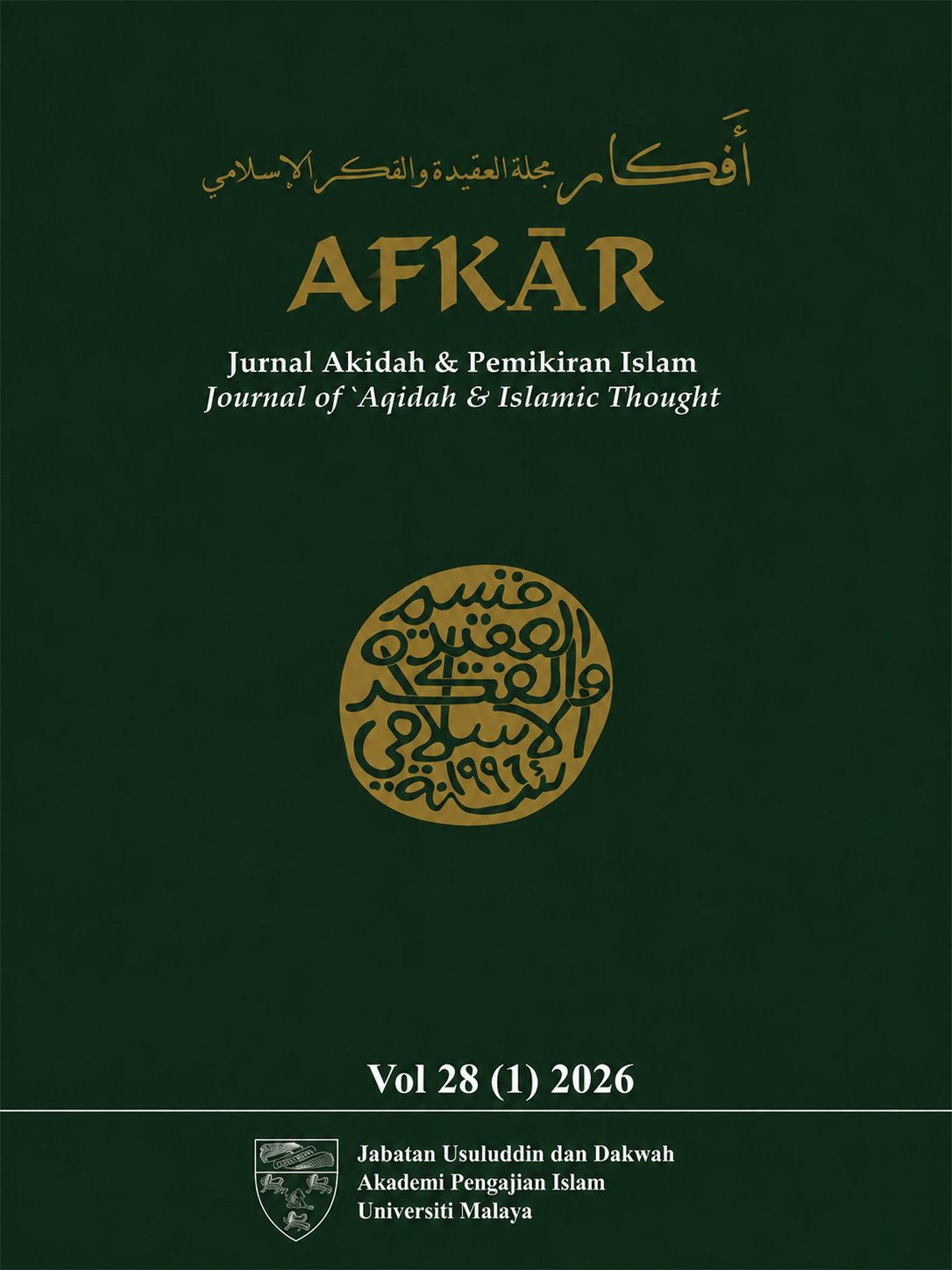
Al-Ghazali and Suhrawardi on the Ontology of Light (Nūr): A Critical Analysis
DOI:
https://doi.org/10.22452/afkar.vol28no1.14Keywords:
Nūr (light), epistemology, ontology, al-Ghazali, al-Suhrawardi, Islamic philosophyAbstract
The concept of light (nūr) occupies a central position in Islamic intellectual history, yet its epistemic function remains insufficiently examined in a systematic and comparative manner. Although Aminrazavi (1997) identified that a comprehensive study on al-Ghazali's influence on al-Suhrawardi remains limited, and despite the attention given by scholars such as Davidson (1992), Marcotte (2007), and Arnzen (2011) to the relationship between these two figures, existing studies do not focus specifically on a systematic comparison of the epistemological and ontological dimensions of light (nūr) between them. Most research is either too general in describing al-Ghazali's influence, or too rigidly separates the two figures into opposing traditions, as reflected in Walbridge (2001). This gap necessitates a more detailed and nuanced comparative study, which serves as the primary objective of this article. The findings of this study reveal that the concept of light (nūr) in the Islamic intellectual tradition develops along two fundamentally distinct paradigms: an epistemological-theological model in the thought of al-Ghazali and an ontological-illuminationist system in the philosophy of al-Suhrawardi. Although both thinkers concur that light is “manifest in itself and makes others manifest” (ẓāhir li dhātih wa muẓhir li ghayrih) and ultimately derives from the Nūr al-Anwār (Light of Lights), their divergence lies in the structural relationship between epistemology and ontology. This study examines the concept of light through a comparative analysis of Mishkāt al-Anwār by al-Ghazali and Ḥikmat al-Ishrāq by al-Suhrawardi, with particular focus on their epistemological and ontological dimensions. It demonstrates that al-Ghazali approaches light within an epistemological-theological framework, wherein light operates as a symbolic language for spiritual cognition and unveiling. In contrast, al-Suhrawardi advances light as the primary ontological principle, effectively displacing the Peripatetic notion of wujūd, constructing a hierarchical metaphysics grounded in degrees of luminous intensity (shiddat al-nūr), from which both reality and knowledge are derived. The study concludes that the discourse on light in Islamic philosophy undergoes a significant transition from a symbolic-theological paradigm to an ontological-illuminationist one.
References
Abū Rayyān, Muḥammad ‘Alī. Uṣūl al-Falsafah al-Ishrāqiyyah ‘ind Shihāb al-Dīn al-Suhrawardī. Cairo: Maktabat al-Anjlū al-Miṣriyyah, 1959.
Al-Daghistani, S. “On Creation, Nature, and the Ethical Self: A Comparative Analysis of Ikhwān al-Ṣafā’, al-Rāghib al-Iṣfahānī, and Abū Ḥāmid al-Ghazālī.” Journal of Islamic Ethics 9(1–2) (2025): 113–134.
Al-Dinanī, Ibrāhīm Ghulām Ḥusayn. Ishrāq al-Fikr wa al-Shuhūd fī Falsafat al-Suhrawardī. Beirut: Dār al-Hādī, 2005.
Al-Ghazālī, Abū Ḥāmid Muḥammad ibn Muḥammad. Iḥyā’ ‘Ulūm al-Dīn. Beirut: Dār al-Ma‘rifah, n.d.
Al-Ghazālī, Abū Ḥāmid Muḥammad. Al-Munqidh min al-Ḍalāl, ed. Jabre, Farid. Beirut: Commission Libanaise pour la Traduction des Chefs-d’Œuvre, 1959.
Al-Ghazālī, Abū Ḥāmid Muḥammad. Mishkāt al-Anwār wa Miṣfāt al-Asrār, ed. al-Lajnah al-‘Ilmiyyah bi Markaz Dār al-Minhāj li al-Dirāsāt wa al-Taḥqīq al-‘Ilmī. Jeddah: Dār al-Minhāj, 2020.
Al-Ghazālī, Abū Ḥāmid Muḥammad. Tahāfut al-Falāsifah, ed. Sulaymān Dunyā. Cairo: Dār al-Ma‘ārif, 1966.
Al-Ghazālī, Abū Ḥāmid Muḥammad. The Niche of Lights (Mishkāt al-Anwār): A Parallel English-Arabic Text, trans. with introduction and notes, Buchman, David. Provo, UT: Brigham Young University Press, 1998.
Al-Ghazālī, Abū Ḥāmid Muḥammad. Mishkāt al-Anwār: The Niche for Lights, trans. Gairdner, W. H. T. Lahore: Sh. Muhammad Ashraf, 1952.
Al-Jurjānī, ‘Alī ibn Muḥammad. al-Ta‘rīfāt: Risālah Iṣṭilāḥāt al-Ṣūfiyyah. Cairo: n.p., 1306 AH.
Al-Juwaynī, ‘Abd al-Malik ibn Yūsuf. Al-Irshād ilā Qawāṭi‘ al-Adillah fī Uṣūl al-I‘tiqād, ed. Mūsā, Muḥammad Yūsuf & ʿAbd al-Ḥamīd, ‘Alī ‘Abd al-Mun‘im. Cairo: Maktabat al-Khānjī, 1950.
Al-Rāghib al-Iṣfahānī, Abū al-Qāsim al-Ḥusayn Ibn Muḥammad. Al-Mufradāt fī Gharīb al-Qur’ān. Beirut: Dār Iḥyā’ al-Turāth al-‘Arabī, n.d.
Al-Suhrawardī, Shihāb al-Dīn Yaḥyā. Ḥikmat al-Ishrāq, ed. and trans. Walbridge, John & Ziai, Hossein. Provo, UT: Brigham Young University Press, 1999.
Al-Suhrawardī, Shihāb al-Dīn Yaḥyā. Majmū‘at Muṣannafāt Shaykh al-Ishrāq, ed. Corbin, Henry. Cairo: al-Hay’ah al-‘Āmmah li-Quṣūr al-Thaqāfah, 2000.
Al-Suhrawardi, Shihab al-Din Yahya. Opera Metaphysica et Mystica, ed. Henry Corbin. Istanbul: Ma‘ārif Maṭbaʿah, 1945.
Al-Suhrawardī, Shihāb al-Dīn. “Al-Alwāḥ al-‘Imādiyyah,” in Kalimat al-Taṣawwuf: Three Treatises, ed. Najaf-Gholi Habibi. Tehran: Imperial Iranian Academy of Philosophy, 1977.
Al-Tahānawī, Muḥammad ibn ‘Alī. Kashshāf Iṣṭilāḥāt al-Funūn wa al-‘Ulūm al-Islāmiyya, ed. ‘Alī Daḥrūj. Beirut: Maktabat Lubnān Nāshirūn, 1996.
Al-Ṭūsī, Muḥammad Ibn al-Ḥasan. al-Tibyān al-Jāmi‘ li-‘Ulūm al-Qur’ān, ed. Al-ʿĀmilī, Aḥmad Qaṣīr. Beirut: Dār Iḥyā’ al-Turāth al-‘Arabī, n.d.
Aristotle. “Metaphysics.” In The Complete Works of Aristotle: The Revised Oxford Translation, ed. Jonathan Barnes 1:1692–1693 (1071b–1073a). Princeton: Princeton University Press, 1984.
Aristotle. “Physics.” In The Complete Works of Aristotle: The Revised Oxford Translation, ed. Jonathan Barnes (2): 428–433 (256a–259a). Princeton: Princeton University Press, 1984.
Atefi, Maryam. “Analysis and Examination of the Origin and Expansion of the Universe in the Qur’an with Emphasis on Light of Lights (Nūr al-Anwār) Suhrawardi’s Theory.” Islamic Heritage and Contemporary Challenges 1(2) (2025): 124.
Beidokhti, Hanif Amin. “Suhrawardi (d. 587/1191) on Eyesight and Vision.” In Islamic Sensory History, ed. Lange, Christian & Bursi, 259–272, Adam. Leiden: Brill, 2024.
Bozyiğit, Ahmet. “Sühreverdî'ye Göre Âlemin Kıdemi Meselesi.” İslâmî Araştırmalar 36(3) (2025): 513–525.
Buzshallu’ī Kumījānī, Shihāb al-Dīn Muḥammad ibn Mūsā. Nūr al-Fu’ād: A Nineteenth-Century Persian Text in Illuminationist Philosophy, ed. and trans. Ziai, Hossein & Asl, Mohammad Karimi Zanjani. Costa Mesa, CA: Mazda Publishers, 2012.
Corbin, Henry. The Man of Light in Iranian Sufism, trans. Nancy Pearson. New Lebanon: Omega Publications, 1994.
Davidson, Herbert A. Alfarabi, Avicenna, and Averroes on Intellect. New York: Oxford University Press, 1992.
Fakhry, Majid. “Al-Suhrawardi’s Critique of the Muslim Peripatetics (al-Mashshāʾūn).” In Philosophies of Existence, Ancient and Modern, ed. Morewedge, Parviz, 279–284. New York: Fordham University Press, 1982.
Gairdner, W. H. T. “Al-Ghazālī's Mishkāt al-Anwār and the Ghazālī Problem.” Der Islam 5 (1914): 133
Griffel, Frank. Al-Ghazālī’s Philosophical Theology. New York: Oxford University Press, 2009.
Gutas, Dimitri. “Essay-Review: Suhrawardi and Greek Philosophy.” Arabic Sciences and Philosophy 13(2003): 303–309.
Ibn Manẓūr, Muḥammad ibn Mukarram. Lisān al-‘Arab. Beirut: Dār Ṣādir, 1414 AH.
Ibn Rushd, Muḥammad ibn Aḥmad. Al-Kashf ‘an Manāhij al-Adillah fī ‘Aqā’id al-Millah, ed. Muḥammad ‘Ābid al-Jābirī. Beirut: Markaz Dirāsāt al-Waḥdah al-‘Arabiyyah, 1998.
Ibn Sīnā, Abū ‘Alī al-Ḥusayn ibn ‘Abd Allāh. Al-Ishārāt wa al-Tanbīhāt, ed. Sulaymān Dunyā. Cairo: Dār al-Ma‘ārif, 1960.
Ingenito, Domenico. “Al-Ghazālī (d. 505/1111) on Visionary Experiences and the Internal and External Senses.” In Islamic Sensory History, ed. Lange, Christian & Bursi, Adam, 364–381. Leiden: Brill, 2024.
Izutsu, Toshihiko. The Concept and Reality of Existence. Tokyo: Keio Institute of Cultural and Linguistic Studies, 1971.
Kaukua, Jari. Suhrawardi’s Illuminationism: A Philosophical Study. Islamic Philosophy, Theology and Science: Texts and Studies 118. Leiden: Brill, 2022.
Kholmuminov, J. M. & Komilov, D. R. “The Philosophy of Light: Hermeneutic Interpretation.” IMRAS 8(6) (2025): 178–194.
Kukkonen, Taneli. “Iḥyāʾ ʿUlūm al-Dīn by Abū Ḥāmid al-Ghazālī.” In Key Classical Works on Islamic Ethics, ed. Mutaz al-Khatib, 206–228. Leiden: Brill, 2024.
Kuspinar, Bilal. Ismā‘īl Ankaravī on the Illuminative Philosophy. Kuala Lumpur: ISTAC, 1996.
Maghribi, Hamdan & Hidayah, Alfina. “Reason, Revelation, and Sufism: The Epistemic Paradigm of al-Ghazali and Ibn Taymiyyah.” Journal of Islamic and Occidental Studies 3(2) (2025): 171–188. https://doi.org/10.21111/jios.v3i2.79
Marcotte, Roxanne D. “Suhrawardī (d. 1191) and His Interpretation of Avicenna’s Philosophical Anthropology.” PhD Thesis McGill University, 2000.
Massignon, Louis. The Passion of al-Ḥallāj: Mystic and Martyr of Islam, trans. Herbert Mason. Princeton: Princeton University Press, 1982.
Mousavian, S. N. “Avicenna, Meaning, and Causation.” The Monist 108(3) (2025): 259–277.
Nasr, Seyyed Hossein. Three Muslim Sages: Avicenna, Suhrawardi, Ibn ‘Arabi. Cambridge, MA: Harvard University Press, 1964.
Rahman, Fazlur. The Philosophy of Mullā Ṣadrā (Ṣadr al-Dīn al-Shīrāzī). Albany, NY: State University of New York Press, 1975.
Razavi, Mehdi Amin. Suhrawardi and the School of Illumination. New York: Routledge, 2013.
Ṣadrā, Mullā. On the Hermeneutics of the Light Verse of the Qurʾān, trans. Peerwani, Latimah-Parvin. London: ICAS Press, 2004.
Sinai, Nicolai. “Al-Suhrawardi’s Philosophy of Illumination and al-Ghazālī.” Archiv für Geschichte der Philosophie 98(3) (2016): 272–301.
Walbridge, John. The Wisdom of the Mystic East: Suhrawardi and Platonic Orientalism. Albany, NY: State University of New York Press, 2001.
Zhang, Tianyi. A Philosophical Enquiry into the Nature of Suhrawardi’s Illuminationism: Light in the Cave. Boston: Brill, 2023.
Ziai, Hossein. “The Illuminationist Tradition.” In History of Islamic Philosophy, ed. Nasr, Seyyed Hossein & Leaman, Oliver, 465–496. London: Routledg
Downloads
Published
Issue
Section
License
Copyright (c) 2026 Afkar: Jurnal Akidah dan Pemikiran Islam

This work is licensed under a Creative Commons Attribution-NonCommercial 4.0 International License.