About the Journal
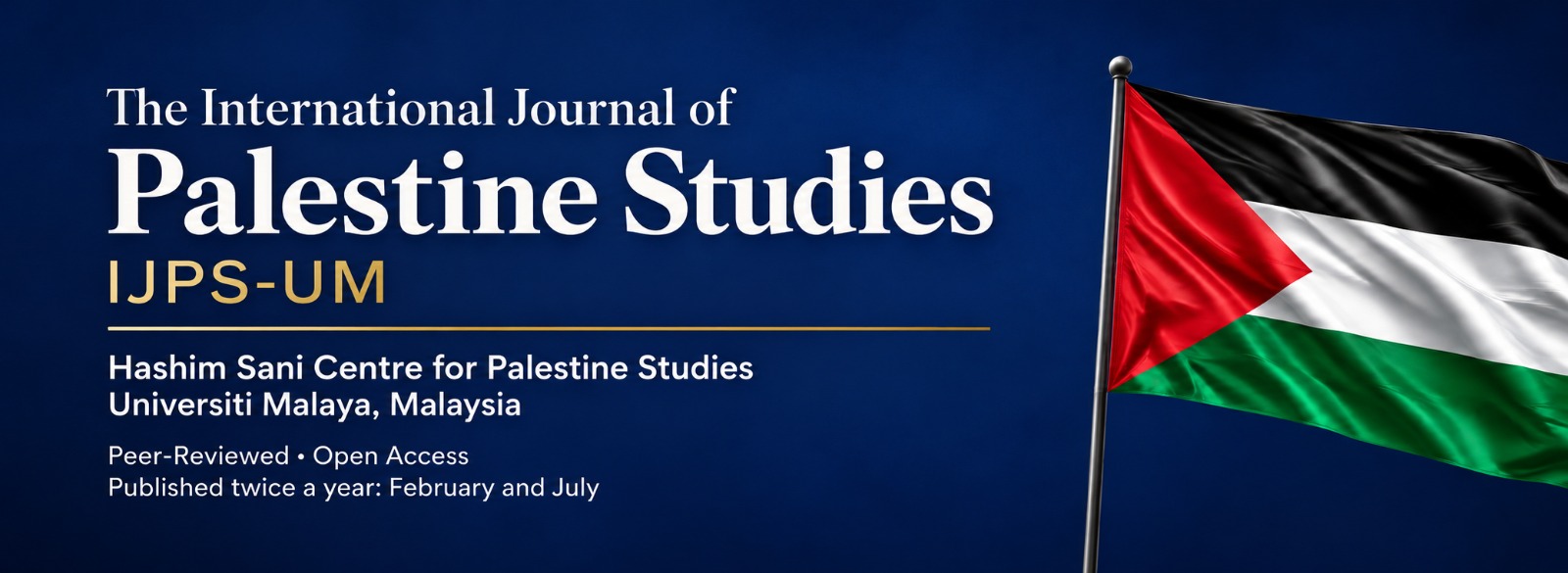
The International Journal of Palestine Studies (IJPS-UM) is a double-blind, peer-reviewed, open-access journal that publishes two issues annually in January and July. Dedicated to advancing knowledge and research on all matters related to Palestine, IJPS addresses broad, common concerns among scholars in areas such as human rights and life under occupation in Palestine, while promoting rigorous empirical research. IJPS-UM is the official journal of the Hashim Sani Centre for Palestine Studies (HSCPS).
All copyright is reserved to the Hashim Sani Centre for Palestine Studies (HSCPS) Universiti Malaya, Malaysia.
AIMS AND SCOPE
Aims
The International Journal of Palestine Studies (IJPS-UM), the official journal of the Hashim Sani Centre for Palestine Studies (HSCPS), Universiti Malaya, advances rigorous, interdisciplinary scholarship on Palestine and Palestinian communities worldwide. It provides a forum for original research and critical analysis of Palestinian history, politics, society, culture and lived experiences, alongside the regional and international forces that shape them.
The journal seeks to deepen understanding of Palestine through theoretically informed and evidence-based inquiry. It gives particular attention to Palestinian perspectives, experiences and knowledge production while encouraging engagement across disciplines, scholarly traditions and geographical contexts. Through this work, IJPS-UM contributes to academic debate and informed public and policy discussion concerning Palestine.
Scope
IJPS-UM welcomes research across the humanities and social sciences, together with interdisciplinary contributions from other fields that have a substantive connection to Palestine. Its scope includes, but is not limited to, the following areas:
1. History, Memory and Colonialism
Palestinian history and historiography; the Nakba and its continuing consequences; Zionism, colonialism and settler colonialism; oral histories, archives, collective memory and historical narratives.
2. Politics, Governance and International Relations
Palestinian political institutions and movements; self-determination and statehood; governance, diplomacy, regional relations and the roles of international actors.
3. International Law, Human Rights and Justice
Occupation, apartheid, genocide, international humanitarian law and human rights; civilian protection, legal accountability, transitional justice and access to remedies.
4. Displacement, Refugees and Diaspora
Forced displacement, exile, statelessness and the right of return; refugee experiences, migration, belonging and relationships between Palestinian communities across borders.
5. Society, Gender and Everyday Life
Social structures and change; gender relations, family life, childhood, youth and disability; community organisation and everyday experiences under conditions of occupation and displacement.
6. Culture, Heritage, Language and Literature
Palestinian cultural expression and identity; literature, translation, religion, arts, film and music; material heritage, cultural preservation and the transmission of knowledge across generations.
7. Media, Communication and Representation
Journalism, political discourse and media framing; representations of Palestine and Palestinians; misinformation, censorship, public opinion and the circulation of narratives across languages and platforms.
8. Education and Knowledge Production
Schooling and higher education; academic freedom, attacks on educational institutions and scholasticide; educational access, curriculum, research practices and the preservation and rebuilding of learning.
9. Health and Psychological Wellbeing
Public health, healthcare access and humanitarian conditions; psychological distress, trauma, disability, community care and the consequences of violence and displacement across generations.
10. Political Economy, Development and the Environment
Labour, livelihoods, trade and economic dependency; blockade and restrictions on movement; land, water, food security, environmental harm, humanitarian assistance and reconstruction.
11. Technology, Surveillance and Digital Life
Artificial intelligence, surveillance and technologies of warfare and control; digital rights, platform governance, online activism and the documentation and preservation of Palestinian experiences.
12. Resistance, Solidarity and Transnational Engagement
Political, social and cultural forms of resistance; civil society, solidarity movements, boycotts and international advocacy, including Palestinian connections with Malaysia, Asia and the wider world.
The journal welcomes empirical, theoretical, conceptual, historical and comparative studies employing appropriate research methods and analytical approaches. Contributions should offer an original scholarly argument, engage critically with relevant literature and demonstrate transparency in their use of evidence. Comparative and regional studies should make a clear and substantive contribution to understanding Palestine or Palestinian experiences.