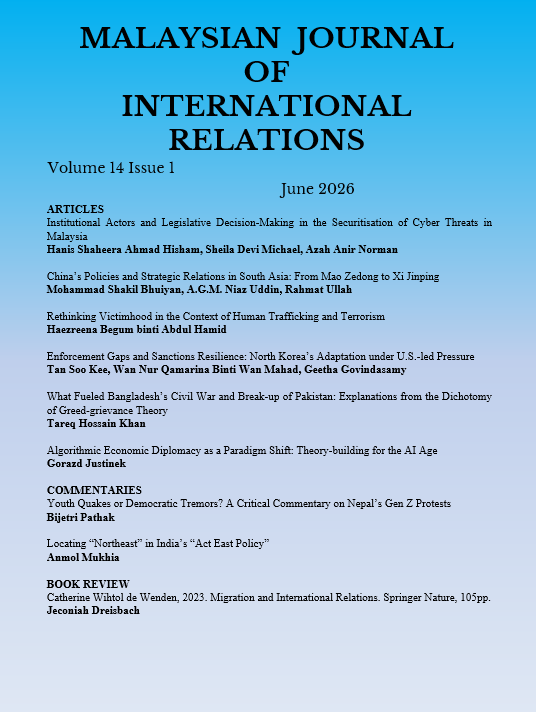
WHAT FUELED BANGLADESH’S CIVIL WAR AND BREAK-UP OF PAKISTAN: EXPLANATIONS FROM THE DICHOTOMY OF GREED-GRIEVANCE THEORY
DOI:
https://doi.org/10.22452//mjir.vol14no1.5Keywords:
Ethnonationalism, Bangladesh war, grievances, greed, relative deprivationAbstract
The greed theory of civil war denotes that economic benefits and rent-seeking behaviour of dissatisfied leaders are the primary causes of the secessionist war, whereas the grievance theory recognises relative deprivation and dissatisfaction as significant reasons for political struggle or civil war. Against this theoretical backdrop, this article examines Bangladesh's Independence War—the first successful secessionist war after the Second World War—through the lenses of both greed and grievance. It specifically argues that greed, the ‘lust for power’, does not adequately explain the motives of volunteer forces, who were more concerned with injustice and ethnonationalism. To substantiate this claim, the article draws on autobiographies of military officers and state documents from Bangladesh, Pakistan, and India as primary sources. These sources reveal that Bengali rebel leaders lacked the natural resources and the independently controlled territories that are typically considered necessary for sustaining resource mobilization in insurgencies. Furthermore, their rebellion did not arise from the opportunity for ‘rebellion-as-business’; rather, the insurgents were compelled to take up arms for survival and relied heavily on the Indian military for weapons, communications and strategic planning, which checked the rebel leaders' monetary interests. Notably, this is the first study attempting to explain a successful secessionist war through the contested theory of greed and grievance. In doing so, the article relates Bangladesh's War of Independence to the political economy of conflict literature, which analyses rebels' motivations in war, and contributes to our understanding of the relationship between ethnonationalism, grievances, and the onset of civil war.