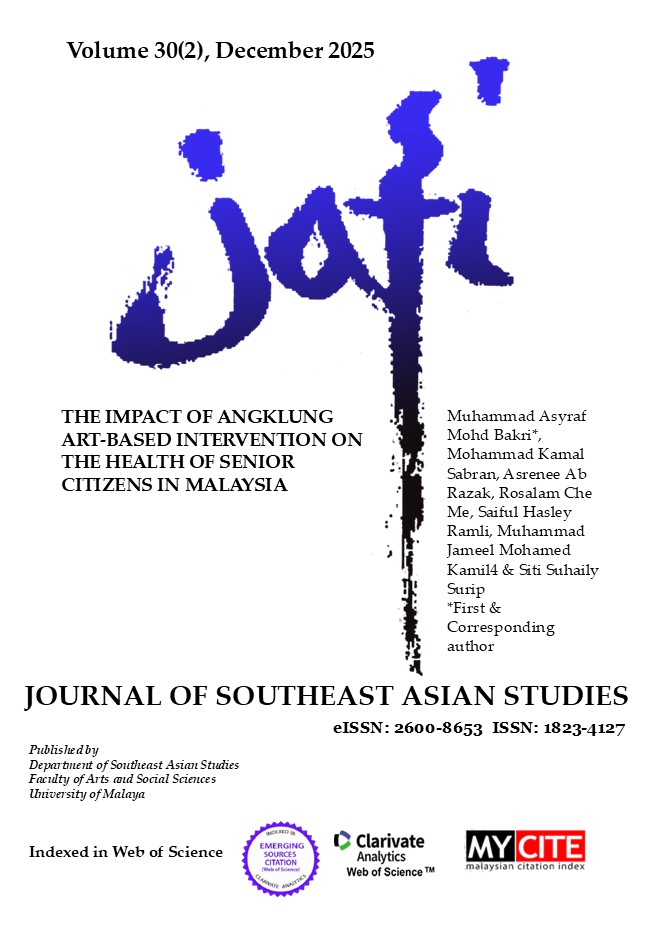
THE IMPACT OF ANGKLUNG ART-BASED INTERVENTION ON THE HEALTH OF SENIOR CITIZENS IN MALAYSIA
DOI:
https://doi.org/10.22452/jati.vol30no2.7Keywords:
angklung, elderly, art-based intervention, quality of life, therapeutic benefitAbstract
This study explores the therapeutic potential of angklung a traditional bamboo musical instrument as an art-based intervention to enhance the well-being of senior citizens in Malaysia. Despite angklung being commonly played for recreational purposes in group settings, its specific health applications remain underexamined. Thus, this study aims to identify the benefits of angklung as an art-based activity for the elderly and to analyse its impact on their physical, psychological, cognitive, and social well-being. This study employed the qualitative descriptive method, and data were collected through literature review and semi-structured interviews. Participants included angklung experts, medical professionals, caregivers and elderly residents from two care centres in Penang. The Angklung Healing Art Project was used as the primary intervention. The collected data were then analysed thematically using the WHOQOL framework, and purposive sampling was employed to ensure sampling diversity. The findings revealed that angklung activities helped improve the participants’ physical and psychological health, independence, social interactions and their overall engagement in daily life. The elderly participants expressed enjoyment, increased motivation, and a sense of accomplishment after being involved in the sessions. Some also reported reduced anxiety and improved memory recall following the intervention. In this light, despite cognitive limitations faced by some of the participants, most were able to participate meaningfully, demonstrating the angklung's accessibility. The melodic and calming tones of the angklung, along with its lightweight and easy-to-play design, make it a suitable tool for therapeutic and recreational purposes in aged care environments. This study has highlighted the importance of incorporating culturally relevant, low-barrier, and enjoyable musical activities into elderly care programs. It also recommends the development of assistive tools to support angklung use among older adults with physical or cognitive limitations.
Downloads
Published
Issue
Section
License
JATI PUBLICATION ETHICS & PUBLICATION MALPRACTICE STATEMENT:
These guidelines are fully consistent with the COPE Principles of Transparency and Best Practice Guidelines and the COPE Code of Conduct (https://publicationethics.org).
We encourage the best standards of publication ethics and take all possible principles of transparency and measures against publication malpractices. The Department of Southeast Asian Studies, as the publisher, plays its role of guardianship over all processes of publishing seriously, and we perform our ethical and other tasks.
- General duties and responsibilities of editors
Editors should be accountable for everything published in their journals. This means the editors should strive to meet the needs of readers and authors; constantly improve their journal; have processes in place to assure the quality of the material they publish; champion freedom of expression; maintain the integrity of the academic record; preclude business needs from compromising intellectual and ethical standards; and always be willing to publish corrections, clarifications, retractions and apologies when needed. In addition to these general duties, the editors accept the obligation to apply best will and practice to cope with the following responsibilities: - Editorial Board
Will generate editorial board from recognized experts in the field. The editor will provide full names and affiliations of the members and updated contact information for the editorial office on the journal webpage. - Duties of Reviewers
Contribution to Editorial Decisions
Peer review assists the editor in making editorial decisions, and through the editorial communications with the author may also assist the author in improving the paper. - Duties of Authors
Reporting standards
Authors should follow the format of reporting the original research with accurate data gathered. The author should include sufficient detail and references to allow others to replicate the work. It is unacceptable if the author performs malpractices in the paper. - Originality and Plagiarism
The authors should ensure that they have produced original articles and must appropriately cite or quote if the authors have used the work and words of others. - Concurrent Publication
It is ethical and acceptable for an author to submit or publish the same research or manuscripts in more than one journal or primary publication. - Acknowledging the Sources
Authors should cite properly publications that have been influential in determining the nature of the reported work. - Paper authorship
Those who have contributed significantly to the paper should be named as an author and co-authors. Those who have participated in the aspects of the research should be listed as contributors. All co-authors should have seen and approved the final version of the paper and have agreed to its submission for publication. - Announcement and Conflicts of Interest
All authors should include the financier or grant giver if the manuscript or research is financed by the research grant or any financial support body. - Errors in published works
The author is responsible for communicating and co-operating with the editor to retract or correct the paper when a significant error or inaccuracy in their published work. - Publication decisions
The editor should decide which of the articles submitted to the journal should be published. The validation of the work in question and its importance to researchers and readers must always drive such decisions. The editor may be guided by the policies of the journal's editorial board and constrained by such legal requirements, copyright infringement, and plagiarism. The editor may confer with other editors or reviewers in making this decision. - Peer review process
All journal's content (articles) are subjected to a double-blind, peer-review process. Articles are first reviewed by editors and may be rejected because it is not dealing with the subject matter. Articles that are found suitable for review are then sent to two experts who are unknown to each other in the field of the paper.
Reviewers are asked to classify the paper as publishable, with amendments and improvements, or rejected. Reviewer's evaluations usually include what to do with the article. The author then sees the reviewer's comments.
Editors should be ready to justify any important points from the described process. Editors should not reverse decisions on publication. Editors should publish guidance to both authors and reviewers on everything expected of them. This guidance should be regularly updated and referred to or linked to this code. - Fair play
The editor should evaluate manuscripts for their intellectual content without regard to race, gender, sexual orientation, religious belief, ethnic origin, citizenship, or political philosophy of the authors. Editors' decision to accept or reject a paper for publication should be based only on the paper's importance, originality and clarity, and the study's relevance to the journal's aim. - Digital Archiving
The editor will ensure digital access to the journal content by the University of Malaya Journal depository section at http://jati-dseas.um.edu.my and MyJournal at http://www.myjurnal.my/public/browse-journal-view.php?id=39. - Confidentiality
Editor and any editorial staff must keep confidential all information about the manuscript's submitted and review process to anyone except the corresponding author, reviewers, potential reviewers, other editorial advisers, and the publisher. - Publication and Submission fee
Authors are freed from submission fees. Authors are required to pay the Article Processing Fee, RM300 or USD80. - Open Access Policy
The journal is freely available online. Authors must agree with this open access policy which enables unrestricted access and reuse of all published articles. The articles are published under the Creative Commons copyright license policy CC-BY. - Reporting standards
Authors of papers should present an accurate account of the work performed and an objective discussion of its significance. Underlying data should be represented accurately in the article. An article should contain sufficient detail and references to permit others to replicate the work. Fraudulent or knowingly inaccurate statements constitute unethical behaviour and are unacceptable. Review and professional publication articles should also be accurate and objective, and editorial 'opinion' works should be identified as such. - Originality and Plagiarism
The authors should ensure that they have written entirely original works and if the authors have used the work and words of others, this has been appropriately cited or quoted.