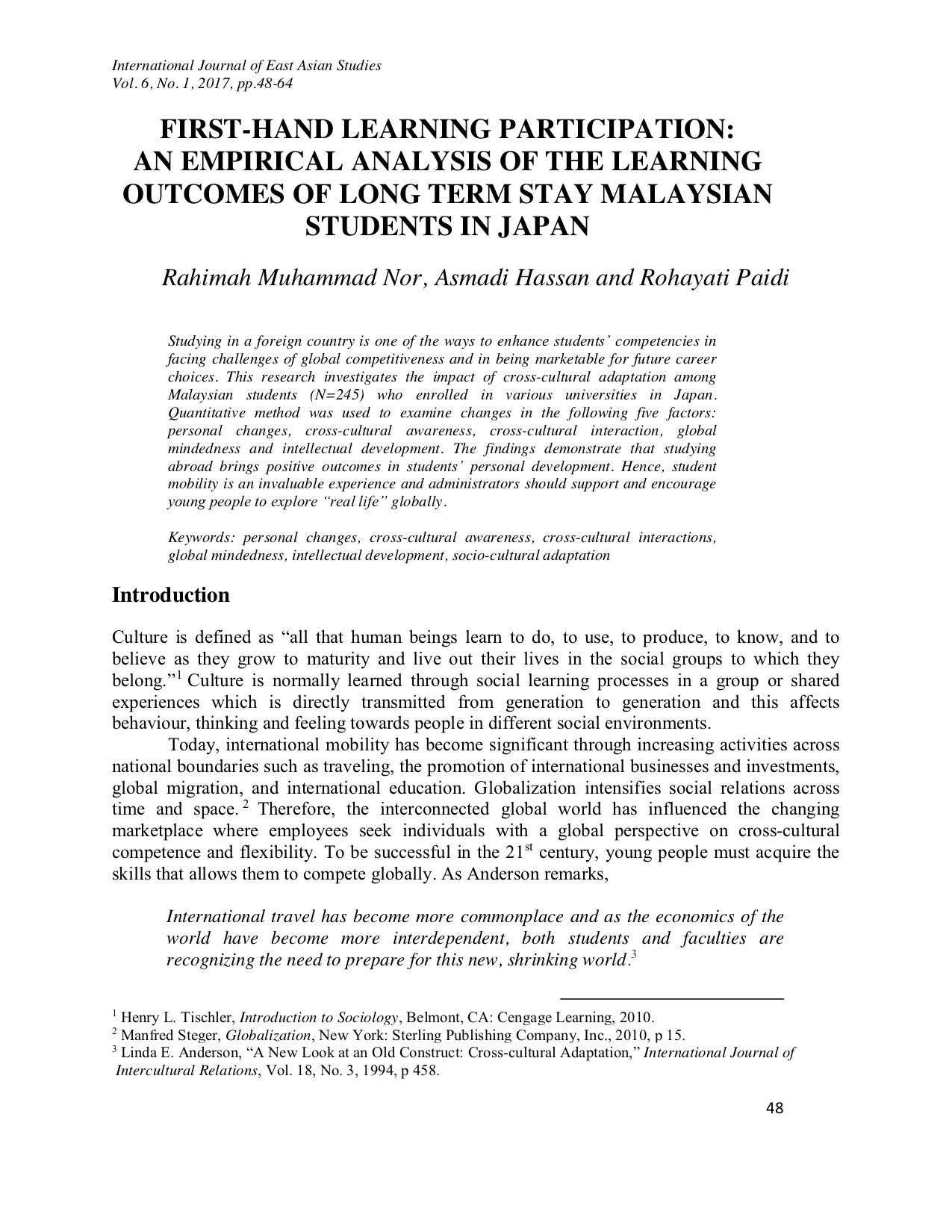
First-Hand Learning Participation: An Empirical Analysis of the Learning Outcomes of Long Term Stay Malaysian Students in Japan
DOI:
https://doi.org/10.22452/IJEAS.vol6no1.4Keywords:
Personal Changes, Cross-Cultural Awareness, Cross-Cultural Interactions, Global Mindedness, Intellectual Development, Socio-Cultural AdaptationAbstract
Studying in a foreign country is one of the ways to enhance students’ competencies in facing challenges of global competitiveness and in being marketable for future career choices. This research investigates the impact of cross-cultural adaptation among Malaysian students (N=245) who enrolled in various universities in Japan. Quantitative method was used to examine changes in the following five factors: personal changes, cross-cultural awareness, cross-cultural interaction, global mindedness and intellectual development. The findings demonstrate that studying abroad brings positive outcomes in students’ personal development. Hence, student mobility is an invaluable experience and administrators should support and encourage young people to explore “real life” globally.
Downloads
Published
Issue
Section
License
Copyright
Submission of a manuscript to the WILAYAH implies that the submitted work has not been published before (except as part of a thesis or report or abstract), that it is not under consideration for publication elsewhere; that all co-authors have approved its publication. The WILAYAH : International Journal of East Asian Studies adopts CC BY license. As such, we would be grateful if an acknowledgement accompanies the republication that the work was originally published in WILAYAH. The editors will ensure digital preservation of access to the journal content by the Journal depository section.
Disclaimer
Although the Department of East Asian Studies is the publisher of the WILAYAH : International Journal of East Asian Studies, the views presented in the WILAYAH are entirely those of the contributors and do not reflect the official stand of the Department of East Asian Studies. The Department does not hold itself responsible for the accuracy of any article published. Publisher and co-publishers assume no responsibility, nor by the editors for any injury and/or damage to persons or property as a result of any actual or alleged libellous statements, infringement of intellectual property or privacy rights, or products liability, whether resulting from negligence or otherwise, or from any use or operation of any ideas, instructions, procedures, products or methods contained in the material therein.