The Potential of the Spatholobus littoralis Hassk Plant as an Antioxidant and Prediction of the Mechanism of Activity Against ROS1 Kinase Receptor in Silico
DOI:
https://doi.org/10.22452/mjs.vol44no2.4Keywords:
Spatholobus littoralis Hassk, antioxidant, ROS1 kinase receptors, In silicoAbstract
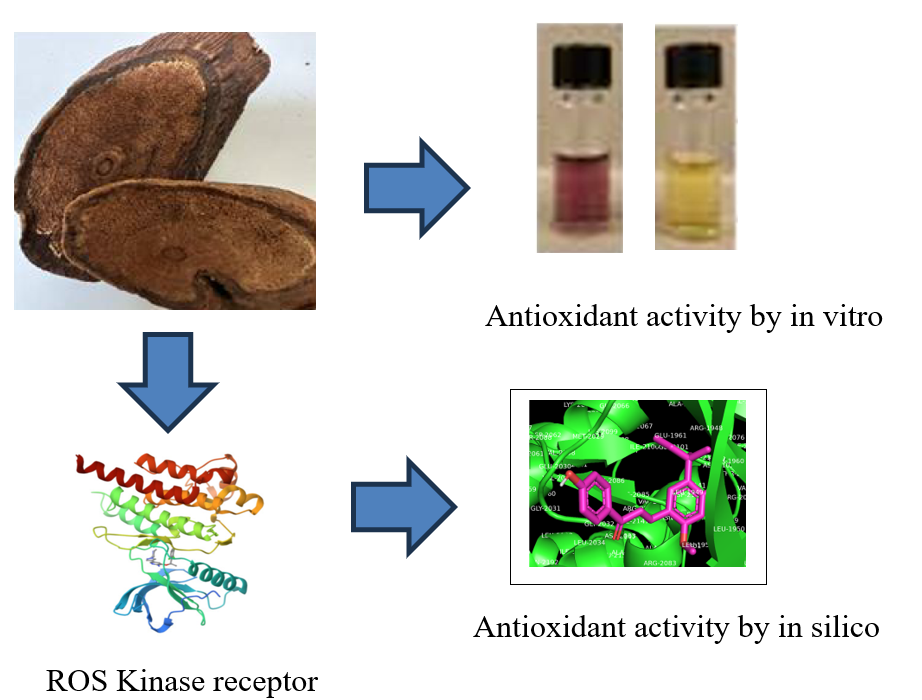
Various phenolic compounds that exhibit antioxidant, anticancer, and anti-inflammatory activities are found in Spatholobus. Therefore, this study aimed to determine the antioxidant potential of Spatholobus littoralis wood in vitro and predict the mechanism of its activity against the ROS1 kinase receptor in silico. The ground-dried wood of S. littoralis was extracted with ethanol via maceration. The analysis of the total phenolic content (TPC) of extracts and fractions obtained from S. littoralis wood was determined by the Folin-Ciocalteu reagent. Similarly, the antioxidant activity was determined by the DPPH (2,2-diphenyl-1-picrylhydrazyl) and FRAP (The ferric reducing antioxidant power) method. The human ROS1 kinase enzyme (4UXL and 3ZBF) was used to determine the molecular mechanism of the interaction from the genus Spatholobus in silico. The total ethanol extract, chloroform, and ethyl acetate fraction of S. littoralis showed a high content of phenolic compounds and antioxidant activity. Phenolic compounds in plants of the genus Spatholubus also showed good activity against ROS1 kinase receptors (3ZBF and 4UXL). In conclusion, the S. littoralis plant has the potential to be developed for the discovery of new drugs.
References
Adhityasmara, D., & Ramonah, D. (2022). Efek hepatoprotektor ekstrak etanol batang bajakah tampala (Spatholobus littoralis hassk) pada tikus yang diinduksi isoniazid. Jurnal Ilmiah Sains, 22(1), 40. https://doi.org/10.35799/jis.v22i1.36293
Aliviyanti, R. U. Y., Sudibyo, R. S., & Murwanti, R. (2021). Efek sitotoksik beberapa akar bajakah kalimantan terhadap sel kanker payudara T47D. Jurnal Penelitian Saintek, 26(2). https://doi.org/10.21831/jps.v26i2.41211
Arysanti, R. D., Wirjatmadi, B., & Winarni, D. (2022). Effect of Bajakah (Spatholobus littoralis Hassk.) extract on malondialdehyde serum of Wistar rats induced by streptozotocin. Jurnal Kesehatan Prima, 16(2), 143. https://doi.org/10.32807/jkp.v16i2.837
Astuti, M. D., Maulana, A., & Kuntowati, E. M. (2014, October 20). Isolasi steroid dari fraksi n-heksana batang kayu bajakah tempala (Spatholobus littoralis Hassk.). Prosiding Seminar Nasional Kimia, Jurusan Kimia FMIPA Universitas Negeri Surabaya.
Atun, S., Handayani, S., Rakhmawati, A., Aini Purnamaningsih, N., An Naila, B. I., & Lestari, A. (2018). Study of potential phenolic compounds from stems of Dendrophthoe falcata (Loranthaceae) plant as antioxidant and antimicrobial agents. Oriental Journal of Chemistry, 34(5), 2342–2349. https://doi.org/10.13005/ojc/340515
Bajorath, J. (2015). Computer-aided drug discovery. F1000Research, 4, 630. https://doi.org/10.12688/f1000research.6653.1
Dai, J., & Mumper, R. J. (2010). Plant phenolics: Extraction, analysis and their antioxidant and anticancer properties. Molecules, 15(10), 7313–7352. https://doi.org/10.3390/molecules15107313
Davies, K. D., & Doebele, R. C. (2013). Molecular pathways: ROS1 fusion proteins in cancer. Clinical Cancer Research, 19(15), 4040–4045. https://doi.org/10.1158/1078-0432.CCR-12-2851
Du, X., Li, Y., Xia, Y.-L., Ai, S.-M., Liang, J., Sang, P., Ji, X.-L., & Liu, S.-Q. (2016). Insights into protein–ligand interactions: Mechanisms, models, and methods. International Journal of Molecular Sciences, 17(2), 144. https://doi.org/10.3390/ijms17020144
Fitriani, F., Sampepana, E., & Saputra, S. H. (2020). Karakterisasi Tumbuhan akar bajakah (Spatholobus littoralis Hassk) dari Loa Kulu Kabupaten Kutai Kartanegara. Jurnal Riset Teknologi Industri, 14(2), 365. https://doi.org/10.26578/jrti.v14i2.6590
Grigalius, I., & Petrikaite, V. (2017). Relationship between antioxidant and anticancer activity of Trihydroxyflavones. Molecules, 22(12), 2169. https://doi.org/10.3390/molecules22122169
Hagerman, A., Harvey-Mueller, I., Makkar, A. H., Mueller, I. H., & Makar, H. P. S. (2000). Quantification of tannins in tree and shrub foliage: A laboratory manual. FAO/IAEA.
Harborne, A. J. (1998). Phytochemical methods a guide to modern techniques of plant analysis (3rd ed.). Springer.
Hill, A. D., & Reilly, P. J. (2008). A Gibbs free energy correlation for automated docking of carbohydrates. Journal of Computational Chemistry, 29(7), 1131–1141. https://doi.org/10.1002/jcc.20873
Huang, X., Fei, Q., Yu, S., Liu, S., Zhang, L., Chen, X., Cao, L., Wang, Z., & Shan, M. (2023). A comprehensive review: Botany, phytochemistry, traditional uses, pharmacology, and toxicology of Spatholobus suberectus vine stems. Journal of Ethnopharmacology, 312, 116500. https://doi.org/10.1016/j.jep.2023.116500
Iskandar, D., Widodo, N., Warsito, Masruri, Rollando, & Antang, Y. P. P. (2022). Phenolic content, antioxidant, cytotoxic of fractions of Spatholobus littoralis Hassk from Kalimantan, Indonesia. Journal of Hunan University Natural Sciences, 49(3), 14–23. https://doi.org/10.55463/issn.1674-2974.49.3.2
Istiqomah, I., & Safitri, D. (2021). Pharmacological activities of Spatholobus littoralis. Infokes : Info Kesehatan, 11(2), 463–469.
Li, W., Liu, J., Guan, R., Chen, J., Yang, D., Zhao, Z., & Wang, D. (2015). Chemical characterization of procyanidins from Spatholobus suberectus and their antioxidative and anticancer activities. Journal of Functional Foods, 12, 468–477. https://doi.org/10.1016/j.jff.2014.11.009
Liu, R.-X., Xu, Y.-L., Ma, L.-F., Ying, Y.-M., & Zhan, Z.-J. (2018). A new flavanone from Spatholobus suberectus dunn. Journal of Chemical Research, 42(10), 529–530. https://doi.org/10.3184/174751918X15386515371813
Milella, R. A., De Rosso, M., Gasparro, M., Gigante, I., Debiase, G., Forleo, L. R., Marsico, A. D., Perniola, R., Tutino, V., Notarnicola, M., Velasco, R., & Flamini, R. (2023). Correlation between antioxidant and anticancer activity and phenolic profile of new Apulian table grape genotypes (V. Vinifera L.). Frontiers in Plant Science, 13. https://doi.org/10.3389/fpls.2022.1064023
Molyneux, P. (2003). The use of the stable radical Diphenylpicrylhydrazyl (DPPH) for estimating antioxidant activity. J.Sci. Technol , 26(2), 211–219.
Nastiti, K., & Nugraha, D. F. (2022). Aktivitas antiinflamasi ekstrak kayu bajakah (Spatholobus littoralis Hask). Jurnal Surya Medika, 7(2), 45–50. https://doi.org/10.33084/jsm.v7i2.3202
Nguyen-Ngoc, H., Vu-Van, T., Pham-Ha-Thanh, T., Le-Dang, Q., & Nguyen-Huu, T. (2022). Ethnopharmacology, phytochemistry, and pharmacological activities of Spatholobus suberectus vine stem. Natural Product Communications, 17(12), 1934578X2211427. https://doi.org/10.1177/1934578X221142724
Peng, F., Zhu, H., Meng, C.-W., Ren, Y.-R., Dai, O., & Xiong, L. (2019). New isoflavanes from Spatholobus suberectus and their cytotoxicity against human breast cancer cell lines. Molecules, 24(18), 3218. https://doi.org/10.3390/molecules24183218
Prasetyorini, B. E., Kusumawardani, A., Fitriani, F., Rachman, P. O., Amelinda, N., & Ramadhani, A. (2022). Analisis in silico senyawa aktif batang kayu bajakah (Spatholobus littoralis hassk) sebagai terapi psoriasis. Herb-Medicine Journal, 5(1), 26. https://doi.org/10.30595/hmj.v5i2.12744
Ridder-Numan, J. W. A., & Wiriadinata, H. (1985). A revision of the genus Spatholobus (Leguminosae-Papilionoideae). Journal on Taxonomic Botany, 10(2), 107–270.
Tejasari, M., Respati, T., & Yuniarti, L. (2022). Exploring anticancer potential in Bajakah tampala by in silico virtual screening. KnE Life Sciences. https://doi.org/10.18502/kls.v7i5.12517
Vanajothi, R., Vedagiri, H., Al-Ansari, M. M., Al-Humaid, L. A., & Kumpati, P. (2022). Pharmacophore based virtual screening, molecular docking and molecular dynamic simulation studies for finding ROS1 kinase inhibitors as potential drug molecules. Journal of Biomolecular Structure and Dynamics, 40(8), 3385–3399. https://doi.org/10.1080/07391102.2020.1847195
Downloads
Published
Issue
Section
License
Copyright (c) 2025 Malaysian Journal of Science

This work is licensed under a Creative Commons Attribution-NonCommercial 4.0 International License.
Transfer of Copyrights
- In the event of publication of the manuscript entitled [INSERT MANUSCRIPT TITLE AND REF NO.] in the Malaysian Journal of Science, I hereby transfer copyrights of the manuscript title, abstract and contents to the Malaysian Journal of Science and the Faculty of Science, University of Malaya (as the publisher) for the full legal term of copyright and any renewals thereof throughout the world in any format, and any media for communication.
Conditions of Publication
- I hereby state that this manuscript to be published is an original work, unpublished in any form prior and I have obtained the necessary permission for the reproduction (or am the owner) of any images, illustrations, tables, charts, figures, maps, photographs and other visual materials of whom the copyrights is owned by a third party.
- This manuscript contains no statements that are contradictory to the relevant local and international laws or that infringes on the rights of others.
- I agree to indemnify the Malaysian Journal of Science and the Faculty of Science, University of Malaya (as the publisher) in the event of any claims that arise in regards to the above conditions and assume full liability on the published manuscript.
Reviewer’s Responsibilities
- Reviewers must treat the manuscripts received for reviewing process as confidential. It must not be shown or discussed with others without the authorization from the editor of MJS.
- Reviewers assigned must not have conflicts of interest with respect to the original work, the authors of the article or the research funding.
- Reviewers should judge or evaluate the manuscripts objective as possible. The feedback from the reviewers should be express clearly with supporting arguments.
- If the assigned reviewer considers themselves not able to complete the review of the manuscript, they must communicate with the editor, so that the manuscript could be sent to another suitable reviewer.
Copyright: Rights of the Author(s)
- Effective 2007, it will become the policy of the Malaysian Journal of Science (published by the Faculty of Science, University of Malaya) to obtain copyrights of all manuscripts published. This is to facilitate:
- Protection against copyright infringement of the manuscript through copyright breaches or piracy.
- Timely handling of reproduction requests from authorized third parties that are addressed directly to the Faculty of Science, University of Malaya.
- As the author, you may publish the fore-mentioned manuscript, whole or any part thereof, provided acknowledgement regarding copyright notice and reference to first publication in the Malaysian Journal of Science and Faculty of Science, University of Malaya (as the publishers) are given. You may produce copies of your manuscript, whole or any part thereof, for teaching purposes or to be provided, on individual basis, to fellow researchers.
- You may include the fore-mentioned manuscript, whole or any part thereof, electronically on a secure network at your affiliated institution, provided acknowledgement regarding copyright notice and reference to first publication in the Malaysian Journal of Science and Faculty of Science, University of Malaya (as the publishers) are given.
- You may include the fore-mentioned manuscript, whole or any part thereof, on the World Wide Web, provided acknowledgement regarding copyright notice and reference to first publication in the Malaysian Journal of Science and Faculty of Science, University of Malaya (as the publishers) are given.
- In the event that your manuscript, whole or any part thereof, has been requested to be reproduced, for any purpose or in any form approved by the Malaysian Journal of Science and Faculty of Science, University of Malaya (as the publishers), you will be informed. It is requested that any changes to your contact details (especially e-mail addresses) are made known.
Copyright: Role and responsibility of the Author(s)
- In the event of the manuscript to be published in the Malaysian Journal of Science contains materials copyrighted to others prior, it is the responsibility of current author(s) to obtain written permission from the copyright owner or owners.
- This written permission should be submitted with the proof-copy of the manuscript to be published in the Malaysian Journal of Science
Licensing Policy
Malaysian Journal of Science is an open-access journal that follows the Creative Commons Attribution-Non-commercial 4.0 International License (CC BY-NC 4.0)
CC BY – NC 4.0: Under this licence, the reusers to distribute, remix, alter, and build upon the content in any media or format for non-commercial purposes only, as long as proper acknowledgement is given to the authors of the original work. Please take the time to read the whole licence agreement (https://creativecommons.org/licenses/by-nc/4.0/legalcode ).