Assessing Diabetes Screening Outcomes in Klang Valley, Malaysia: A Cross-Sectional Study
DOI:
https://doi.org/10.22452/mjs.vol44sp1.3Keywords:
health screening, diabetes, prevalenceAbstract
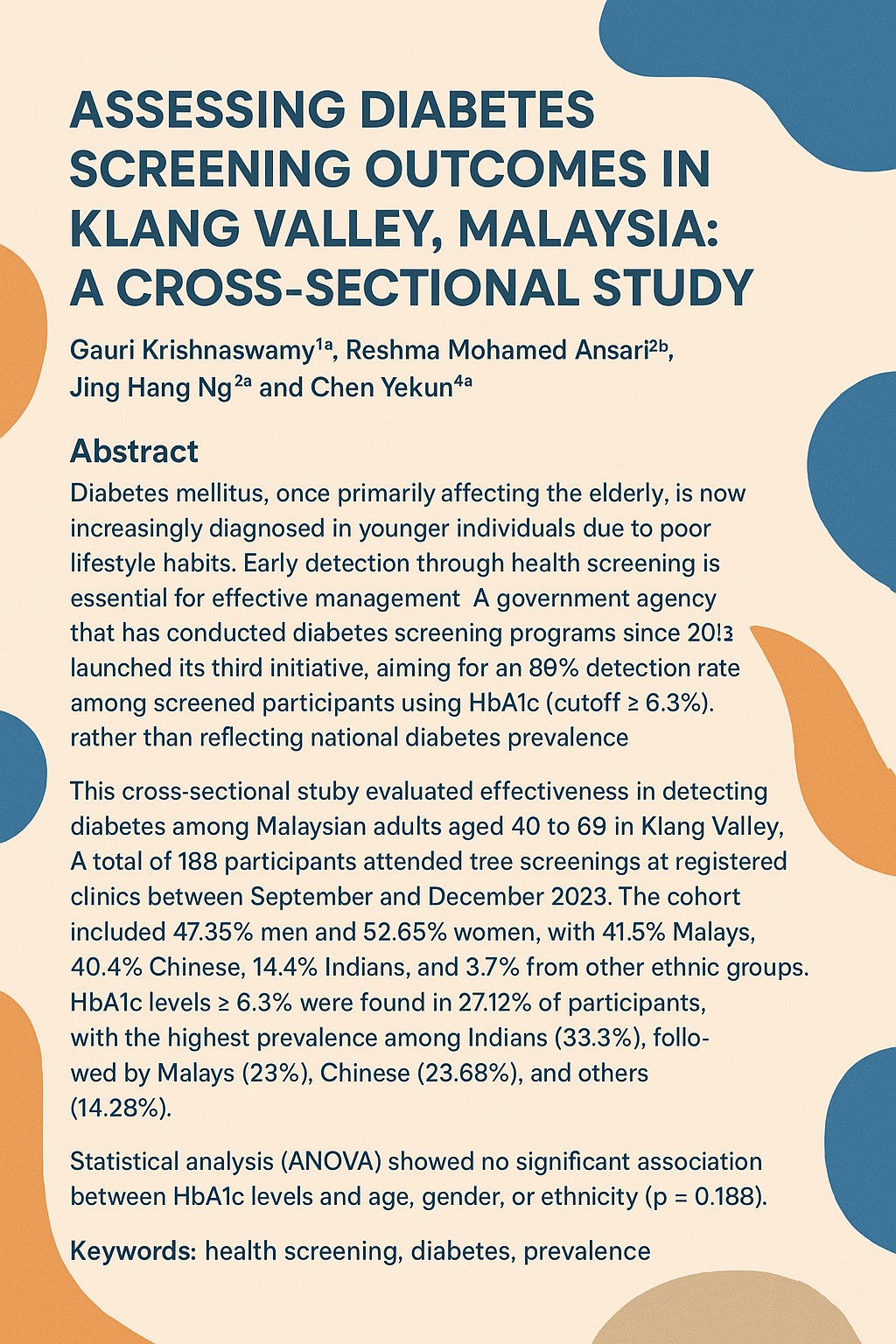
Diabetes mellitus, once primarily affecting the elderly, is now increasingly diagnosed in younger individuals due to poor lifestyle habits. Early detection through health screening is essential for effective management. A government agency that has conducted diabetes screening programs since 2013 launched its third initiative, aiming for an 80% detection rate among screened participants using HbA1c (cutoff ≥ 6.3%), rather than reflecting national diabetes prevalence. This cross-sectional study evaluated the program’s effectiveness in detecting diabetes among Malaysian adults aged 40 to 59 in Klang Valley. A total of 188 participants attended free screenings at registered clinics between September and December 2023. The cohort included 47.35% men and 52.65% women, with 41.5% Malays, 40.4% Chinese, 14.4% Indians, and 3.7% from other ethnic groups. HbA1c levels ≥ 6.3% were found in 27.12% of participants, with the highest prevalence among Indians (33.3%), followed by Malays (29%), Chinese (23.68%), and others (14.28%). Statistical analysis (ANOVA) showed no significant association between HbA1c levels and age, gender, or ethnicity (p = 0.188). The program did not meet its 80% detection target, suggesting that alternative screening approaches, including revised diagnostic criteria or additional risk assessments, may be needed to improve diabetes detection and intervention efforts.
References
Ahmed, S. F., Hassan, A. A., Eltayeb, M. M., Omar, S. M., & Adam, I. (2023). Ethnicity, Age, and Gender Differences in Glycated Hemoglobin (HbA1c) Levels among Adults in Northern and Eastern Sudan: A Community-Based Cross-Sectional Study. Life (Basel, Switzerland), 13(10), 2017. https://doi.org/10.3390/life13102017
American College of Sports Medicine. (n.d.). Exercise is medicine: About. Retrieved from https://www.exerciseismedicine.org/support_page.php/about/
Bommer, C., Heesemann, E., Sagalova, V., Manne-Goehler, J., Atun, R., Bärnighausen, T., & Vollmer, S. (2017). The global economic burden of diabetes in adults aged 20–79 years: a cost-of-illness study. The Lancet Diabetes & Endocrinology, 5(6), 423–430. https://doi.org/10.1016/s2213-8587(17)30097-9
Ganasegeran, K., Hor, C. P., Jamil, M. F. A., Suppiah, P. D., Noor, J. M., Hamid, N. A., Chuan, D. R., Manaf, M. R. A., Ch'ng, A. S. H., & Looi, I. (2021). Mapping the Scientific Landscape of Diabetes Research in Malaysia (2000-2018): A Systematic Scientometrics Study. International journal of environmental research and public health, 18(1), 318. https://doi.org/10.3390/ijerph18010318
Ghazanfari, Z., Haghdoost, A. A., Alizadeh, S. M., Atapour, J., & Zolala, F. (2010). A Comparison of HbA1c and Fasting Blood Sugar Tests in General Population. International journal of preventive medicine, 1(3), 187–194.
Institute for Public Health. (2020). National Health and Morbidity Survey (NHMS) 2019: Non-communicable diseases, healthcare demand, and health literacy. Ministry of Health Malaysia. https://iku.moh.gov.my
International Diabetes Federation. (2021). IDF Diabetes Atlas (10th ed.). International Diabetes Federation. https://diabetesatlas.org
Ismail, I. S., Nazaimoon, W. M., Mohamad, W. B., Letchuman, R., Singaraveloo, M., Pendek, R., Faridah, I., Rasat, R., Sheriff, I. H., & Khalid, B. A. (2000). Sociodemographic determinants of glycaemic control in young diabetic patients in peninsular Malaysia. Diabetes research and clinical practice, 47(1), 57–69. https://doi.org/10.1016/s0168-8227(99)00104-7
Li, Y., et al. (2020). China’s response to diabetes: A comprehensive review of China’s diabetes burden, programs, and policies. Journal of Diabetes Research, 2020, Article ID 9654934. https://doi.org/10.1155/2020/9654934
Ma, Q., Liu, H., Xiang, G., Shan, W., & Xing, W. (2016). Association between glycated hemoglobin A1c levels with age and gender in Chinese adults with no prior diagnosis of diabetes mellitus. Biomedical reports, 4(6), 737–740. https://doi.org/10.3892/br.2016.643
Magliano, D. J., Boyko, E. J., IDF Diabetes Atlas Writing Group, & Shaw, J. E. (2024). The global burden of diabetes and risk factors: 1990–2022. The Lancet Diabetes & Endocrinology, 12(2), 89–102. https://doi.org/10.1016/S2213-8587(24)00021-9
Masuch, A., Friedrich, N., Roth, J., Nauck, M., Müller, U.A., & Petersmann, A. (2019). Preventing misdiagnosis of diabetes in the elderly: age-dependent HbA1c reference intervals derived from two population-based study cohorts. BMC Endocrine Disorders, 19.
Ministry of Health Malaysia. (2013). Health facts 2013. Ministry of Health Malaysia. https://www.moh.gov.my/moh/resources/Penerbitan/Penerbitan%20Utama/HEALTH%20FACTS/HEALTH%20FACTS%202013.pdf
Ministry of Health Malaysia. (2013). National Strategic Plan for Non-Communicable Diseases (NSPNCD). Putrajaya: Ministry of Health Malaysia.
Ministry of Health Malaysia. (2020). National Health and Morbidity Survey 2020: Diabetes prevalence report. Ministry of Health Malaysia.
Ministry of Health Malaysia. 2021. National Diabetes Registry Report 2020
Ministry of Health Malaysia. (2020). Management of Type 2 Diabetes Mellitus (6th ed.).
Ministry of Health Malaysia. https://www.moh.gov.my/moh/resources/Penerbitan/CPG/Endocrine/CPG_T2DM_6th_Edition_2020_13042021.pdf
Ministry of Health Malaysia. (2022). The direct healthcare cost of non-communicable diseases in Malaysia. MOH. https://www.moh.gov.my/moh/resources/Penerbitan/Rujukan/NCD/NCD_Laporan/HEALTH-COST_of_NCDs-7a-WEB.pdf
Ministry of Health Singapore. (2021). War on diabetes: Singapore’s response to tackling diabetes. https://www.healthhub.sg/programmes/180/war-on-diabetes
Mohamud, W. N., Musa, K. I., Khir, A. S., Ismail, A. A., Ismail, I. S., Kadir, K. A., Kamaruddin, N. A., Yaacob, N. A., Mustafa, N., Ali, O., Isa, S. H., & Bebakar, W. M. (2011). Prevalence of overweight and obesity among adult Malaysians: an update. Asia Pacific journal of clinical nutrition, 20(1), 35–41.
NCD Risk Factor Collaboration (NCD-RisC) (2023). Global variation in diabetes diagnosis and prevalence based on fasting glucose and hemoglobin A1c. Nature medicine, 29(11), 2885–2901. https://doi.org/10.1038/s41591-023-02610-2
NHS England. (2019). NHS Diabetes Prevention Programme: Information for health care professionals. Retrieved from https://www.england.nhs.uk/diabetes/diabetes-prevention/
Saeedi, P., Petersohn, I., Salpea, P., Malanda, B., Karuranga, S., Unwin, N., Colagiuri, S., Guariguata, L., Motala, A. A., Ogurtsova, K., Shaw, J. E., Bright, D., & Williams, R. (2019). Global and regional diabetes prevalence estimates for 2019 and projections for 2030 and 2045: Results from the International Diabetes Federation Diabetes Atlas, 9th edition. Diabetes Research and Clinical Practice, 157, 107843. https://doi.org/10.1016/j.diabres.2019.107843
Seuring, T., Archangelidi, O., & Suhrcke, M. (2015). The Economic Costs of Type 2 Diabetes: A Global Systematic Review. PharmacoEconomics, 33(8), 811–831. https://doi.org/10.1007/s40273-015-0268-9
Social Security Organization (SOCSO). (2023). Health Screening Program (HSP 3.0). Retrieved from https://www.perkeso.gov.my/en/perkhidmatan-kami/perkhidmatan-lain/belanjawan-2023/program-saringan-kesihatan-hsp3-0.html
The Global Economy. (2023). Diabetes prevalence in Southeast Asia: Country rankings 2023. https://www.theglobaleconomy.com/rankings/diabetes_prevalence/South-East-Asia
Wan Nazaimoon, W. M., Md Isa, S. H., Wan Mohamad, W. B., Khir, A. S., Kamaruddin, N. A., Kamarul, I. M., Mustafa, N., Ismail, I. S., Ali, O., & Khalid, B. A. (2013). Prevalence of diabetes in Malaysia and usefulness of HbA1c as a diagnostic criterion. Diabetic medicine : a journal of the British Diabetic Association, 30(7), 825–828. https://doi.org/10.1111/dme.12161
World Health Organization. (2024). Urgent action needed as global diabetes cases increase fourfold over past decades. https://www.who.int/news/item/13-11-2024-urgent-action-needed-as-global-diabetes-cases-increase
Downloads
Published
Issue
Section
License
Copyright (c) 2025 Malaysian Journal of Science

This work is licensed under a Creative Commons Attribution-NonCommercial 4.0 International License.
Transfer of Copyrights
- In the event of publication of the manuscript entitled [INSERT MANUSCRIPT TITLE AND REF NO.] in the Malaysian Journal of Science, I hereby transfer copyrights of the manuscript title, abstract and contents to the Malaysian Journal of Science and the Faculty of Science, University of Malaya (as the publisher) for the full legal term of copyright and any renewals thereof throughout the world in any format, and any media for communication.
Conditions of Publication
- I hereby state that this manuscript to be published is an original work, unpublished in any form prior and I have obtained the necessary permission for the reproduction (or am the owner) of any images, illustrations, tables, charts, figures, maps, photographs and other visual materials of whom the copyrights is owned by a third party.
- This manuscript contains no statements that are contradictory to the relevant local and international laws or that infringes on the rights of others.
- I agree to indemnify the Malaysian Journal of Science and the Faculty of Science, University of Malaya (as the publisher) in the event of any claims that arise in regards to the above conditions and assume full liability on the published manuscript.
Reviewer’s Responsibilities
- Reviewers must treat the manuscripts received for reviewing process as confidential. It must not be shown or discussed with others without the authorization from the editor of MJS.
- Reviewers assigned must not have conflicts of interest with respect to the original work, the authors of the article or the research funding.
- Reviewers should judge or evaluate the manuscripts objective as possible. The feedback from the reviewers should be express clearly with supporting arguments.
- If the assigned reviewer considers themselves not able to complete the review of the manuscript, they must communicate with the editor, so that the manuscript could be sent to another suitable reviewer.
Copyright: Rights of the Author(s)
- Effective 2007, it will become the policy of the Malaysian Journal of Science (published by the Faculty of Science, University of Malaya) to obtain copyrights of all manuscripts published. This is to facilitate:
- Protection against copyright infringement of the manuscript through copyright breaches or piracy.
- Timely handling of reproduction requests from authorized third parties that are addressed directly to the Faculty of Science, University of Malaya.
- As the author, you may publish the fore-mentioned manuscript, whole or any part thereof, provided acknowledgement regarding copyright notice and reference to first publication in the Malaysian Journal of Science and Faculty of Science, University of Malaya (as the publishers) are given. You may produce copies of your manuscript, whole or any part thereof, for teaching purposes or to be provided, on individual basis, to fellow researchers.
- You may include the fore-mentioned manuscript, whole or any part thereof, electronically on a secure network at your affiliated institution, provided acknowledgement regarding copyright notice and reference to first publication in the Malaysian Journal of Science and Faculty of Science, University of Malaya (as the publishers) are given.
- You may include the fore-mentioned manuscript, whole or any part thereof, on the World Wide Web, provided acknowledgement regarding copyright notice and reference to first publication in the Malaysian Journal of Science and Faculty of Science, University of Malaya (as the publishers) are given.
- In the event that your manuscript, whole or any part thereof, has been requested to be reproduced, for any purpose or in any form approved by the Malaysian Journal of Science and Faculty of Science, University of Malaya (as the publishers), you will be informed. It is requested that any changes to your contact details (especially e-mail addresses) are made known.
Copyright: Role and responsibility of the Author(s)
- In the event of the manuscript to be published in the Malaysian Journal of Science contains materials copyrighted to others prior, it is the responsibility of current author(s) to obtain written permission from the copyright owner or owners.
- This written permission should be submitted with the proof-copy of the manuscript to be published in the Malaysian Journal of Science
Licensing Policy
Malaysian Journal of Science is an open-access journal that follows the Creative Commons Attribution-Non-commercial 4.0 International License (CC BY-NC 4.0)
CC BY – NC 4.0: Under this licence, the reusers to distribute, remix, alter, and build upon the content in any media or format for non-commercial purposes only, as long as proper acknowledgement is given to the authors of the original work. Please take the time to read the whole licence agreement (https://creativecommons.org/licenses/by-nc/4.0/legalcode ).