The Role of The EphrinB2-EphB4 Bidirectional Signalling on Bone Remodeling: A Review
DOI:
https://doi.org/10.22452/mjs.vol44sp1.1Keywords:
EphrinB2, EphB4, Bone remodeling, Osteoclast, OsteoblastAbstract
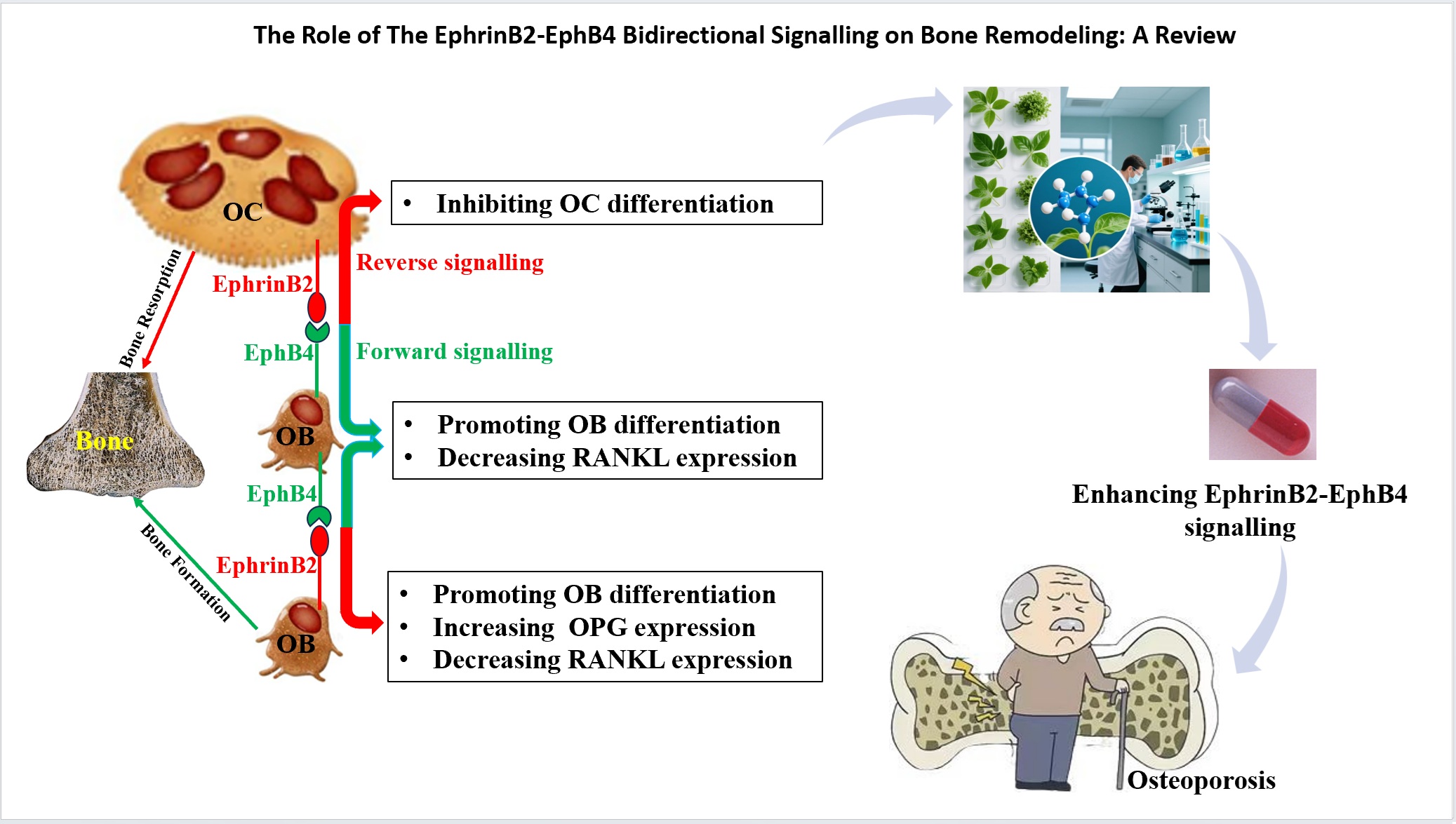
Postmenopausal osteoporosis is a prevalent disease that can lead to serious outcomes such as fractures. Oestrogen deficiency during menopause and postmenopause increases bone turnover, with elevated bone resorption and formation. However, resorption surpasses formation, resulting in bone loss. Identifying intervention targets in bone physiology to restore bone remodeling balance and normal bone mass is the initial aim in developing new effective therapies. Currently, EphrinB2/EphB4, one of the membrane coupling factors between osteoclasts (OCs) and osteoblasts (OBs), is a prominent topic in bone disease research. However, the regulatory mechanisms of EphrinB2-EphB4 bidirectional signalling on OC and OB and its effects remain incompletely understood. This review seeks to clarify the physiological roles and mechanisms of known EphrinB2-EphB4 bidirectional signalling in bone remodeling, providing insights for future studies on modulating this signalling pathway.
References
Allan, E. H., Hausler, K. D., Wei, T., Gooi, J. H., Quinn, J. M., Crimeen-Irwin, B., Pompolo, S., Sims, N. A., Gillespie, M. T., Onyia, J. E., & Martin, T. J. (2008). EphrinB2 regulation by PTH and PTHrP revealed by molecular profiling in differentiating osteoblasts, Journal of Bone and Mineral Research. 23(8):1170-1181.
Arthur, A., Zannettino, A., Panagopoulos, R., Koblar, S. A., Sims, N. A., Stylianou, C., Matsuo, K., & Gronthos, S. (2011). EphB/ephrin-B interactions mediate human MSC attachment, migration and osteochondral differentiation, Bone. 48(3):533-542.
Arthur, A., & Gronthos, S. (2021). Eph-Ephrin Signaling Mediates Cross-Talk Within the Bone Microenvironment, Front Cell Dev Biol. 9:598612.
Arvanitis, D., & Davy, A. (2008). Eph/ephrin signaling: networks, Genes Dev. 22(4):416-429.
Baek, J. M., Cheon, Y., Kwak, S. C., Jun, H. Y., Yoon, K., Lee, M. S., & Kim, J. (2018). Claudin 11 regulates bone homeostasis via bidirectional EphB4-EphrinB2 signaling, Experimental & Molecular Medicine. 50(4):1-18.
Blank, M., & Sims, N. A. (2019). Cellular Processes by Which Osteoblasts and Osteocytes Control Bone Mineral Deposition and Maturation Revealed by Stage-Specific EphrinB2 Knockdown, Current Osteoporosis Reports. 17(5):270-280.
Davy, A., Bush, J. O., & Soriano, P. (2006). Inhibition of gap junction communication at ectopic Eph/ephrin boundaries underlies craniofrontonasal syndrome, Plos Biology. 4(10):e315.
Durdan, M. M., Azaria, R. D., & Weivoda, M. M. (2022). Novel insights into the coupling of osteoclasts and resorption to bone formation, Seminars in Cell & Developmental Biology. 123:4-13.
Feng, X., & McDonald, J. M. (2011). Disorders of Bone Remodeling, Annual Review of Pathology: Mechanisms of Disease. 6(1):121-145.
Flanagan, J. G., & Vanderhaeghen, P. (1998). The ephrins and Eph receptors in neural development, Annual Review of Neuroscience. 21:309-345.
Ge, Y., Feng, K., Liu, X., Chen, H., Sun, Z., Wang, C., Liu, Z., Wang, H., Zhang, J., Yu, D., & Mao, Y. (2020). The Recombinant Protein EphB4-Fc Changes the Ti Particle-Mediated Imbalance of OPG/RANKL via EphrinB2/EphB4 Signaling Pathway and Inhibits the Release of Proinflammatory Factors In Vivo, Oxidative Medicine and Cellular Longevity. 2020:1-15.
Hadjimichael, A. C., Pergaris, A., Kaspiris, A., Foukas, A. F., Kokkali, S., Tsourouflis, G., & Theocharis, S. (2022). The EPH/Ephrin System in Bone and Soft Tissue Sarcomas’ Pathogenesis and Therapy: New Advancements and a Literature Review, International Journal of Molecular Sciences. 23(9):5171.
Huang, M., Wang, Y., & Peng, R. (2020). Icariin Alleviates Glucocorticoid-Induced Osteoporosis through EphB4/Ephrin-B2 Axis, Evidence-Based Complementary and Alternative Medicine. 2020:1-8.
Jiang, Y., Tao, G., Guan, Y., Chen, S., He, Y., Li, T., Zou, S., & Li, Y. (2023). The role ofephrinB2‐EphB4 signalling in bone remodelling during orthodontic tooth movement, Orthodontics & Craniofacial Research. 26(1), 107-116.
Kania, A., & Klein, R. (2016). Mechanisms of ephrin-Eph signalling in development, physiology and disease, Nat Rev Mol Cell Biol. 17(4):240-256.
Kenkre, J. S., & Bassett, J. (2018). The bone remodelling cycle, Annals of Clinical Biochemistry: International Journal of Laboratory Medicine. 55(3):308-327.
Kertesz, N., Krasnoperov, V., Reddy, R., Leshanski, L., Kumar, S. R., Zozulya, S., & Gill, P. S. (2006). The soluble extracellular domain of EphB4 (sEphB4) antagonizes EphB4-EphrinB2 interaction, modulates angiogenesis, and inhibits tumor growth, Blood. 107(6):2330-2338.
Khosla, S., & Hofbauer, L. C. (2017). Osteoporosis treatment: recent developments and ongoing challenges, Lancet Diabetes Endocrinol. 5(11):898-907.
Li, C., Shi, C., Kim, J., Chen, Y., Ni, S., Jiang, L., Zheng, C., Li, D., Hou, J., Taichman, R. S., & Sun, H. (2015). Erythropoietin Promotes Bone Formation through EphrinB2/EphB4 Signaling, Journal of Dental Research. 94(3):455-463.
Li, W., Wen, L., Rathod, B., Gingras, A., Ley, K., & Lee, H. (2022). Kindlin2 enables EphB/ephrinB bi-directional signaling to support vascular development, Life Science Alliance. 6(3):e202201800.
Liang, L. Y., Patel, O., Janes, P. W., Murphy, J. M., & Lucet, I. S. (2019). Eph receptor signalling: from catalytic to non-catalytic functions, Oncogene. 38(39):6567-6584.
Lindsey, R. C., Rundle, C. H., & Mohan, S. (2018). Role of IGF1 and EFN-EPH signaling in skeletal metabolism, Journal of Molecular Endocrinology. 61(1):T87-T102.
Matsuo, K. (2010). Eph and ephrin interactions in bone, Advances in Experimental Medicine and Biology, 658, 95-103.
McDonald, M. M., Khoo, W. H., Ng, P. Y., Xiao, Y., Zamerli, J., Thatcher, P., Kyaw, W., Pathmanandavel, K., Grootveld, A. K., Moran, I., Butt, D., Nguyen, A., Corr, A., Warren, S., Biro, M., Butterfield, N. C., Guilfoyle, S. E., Komla-Ebri, D., Dack, M., Dewhurst, H. F., Logan, J. G., Li, Y., Mohanty, S. T., Byrne, N., Terry, R. L., Simic, M. K., Chai, R., Quinn, J., Youlten, S. E., Pettitt, J. A., Abi-Hanna, D., Jain, R., Weninger, W., Lundberg, M., Sun, S., Ebetino, F. H., Timpson, P., Lee, W. M., Baldock, P. A., Rogers, M. J., Brink, R., Williams, G. R., Bassett, J., Kemp, J. P., Pavlos, N. J., Croucher, P. I., & Phan, T. G. (2021). Osteoclasts recycle via osteomorphs during RANKL-stimulated bone resorption, Cell. 184(5):1330-1347.
Negishi-Koga, T., Shinohara, M., Komatsu, N., Bito, H., Kodama, T., Friedel, R. H., & Takayanagi, H. (2011). Suppression of bone formation by osteoclastic expression of semaphorin 4D, Nature Medicine. 17(11), 1473-1480.
Nguyen, T. M., Arthur, A., & Gronthos, S. (2016). The role of Eph/ephrin molecules in stromal-hematopoietic interactions, International Journal of Hematology. 103(2):145-154.
NIH Consensus Development Panel On Osteoporosis Prevention, D. A. T. (2001). Osteoporosis prevention, diagnosis, and therapy, JAMA. 285(6):785-795.
Pasquale, E. B. (2005). Eph receptor signalling casts a wide net on cell behaviour, Nat Rev Mol Cell Biol. 6(6), 462-475.
Pasquale, E. B. (2008). Eph-ephrin bidirectional signaling in physiology and disease, Cell. 133(1):38-52.
Raisz, L. G. (2005). Pathogenesis of osteoporosis: concepts, conflicts, and prospects, Journal of Clinical Investigation. 115(12):3318-3325.
Rong, X., Kou, Y., Zhang, Y., Yang, P., Tang, R., Liu, H., & Li, M. (2022). ED-71 Prevents Glucocorticoid-Induced Osteoporosis by Regulating Osteoblast Differentiation via Notch and Wnt/beta-Catenin Pathways, Drug Des Devel Ther. 16:3929-3946.
Shindo, S., Savitri, I. J., Ishii, T., Ikeda, A., Pierrelus, R., Heidari, A., Okubo, K., Nakamura, S., Kandalam, U., Rawas-Qalaji, M., Leon, E., Pastore, M. R., Hardigan, P., & Kawai, T. (2022). Dual-Function Semaphorin 4D Released by Platelets: Suppression of Osteoblastogenesis and Promotion of Osteoclastogenesis, International Journal of Molecular Sciences. 23(6):2938.
Takyar, F. M., Tonna, S., Ho, P. W., Crimeen-Irwin, B., Baker, E. K., Martin, T. J., & Sims, N. A. (2013). EphrinB2/EphB4 inhibition in the osteoblast lineage modifies the anabolic response to parathyroid hormone, Journal of Bone and Mineral Research. 28(4):912-925.
Tang, Y., Wu, X., Lei, W., Pang, L., Wan, C., Shi, Z., Zhao, L., Nagy, T. R., Peng, X., Hu, J., Feng, X., Van Hul, W., Wan, M., & Cao, X. (2009). TGF-beta1-induced migration of bone mesenchymal stem cells couples bone resorption with formation, Nature Medicine. 15(7):757-765.
Tonna, S., Takyar, F. M., Vrahnas, C., Crimeen Irwin, B., Ho, P. W. M., Poulton, I. J., Brennan, H. J., McGregor, N. E., Allan, E. H., Nguyen, H., Forwood, M. R., Tatarczuch, L., Mackie, E. J., Martin, T. J., & Sims, N. A. (2014). EphrinB2 signaling in osteoblasts promotes bone mineralization by preventing apoptosis, The FASEB Journal. 28(10):4482-4496.
Vrahnas, C., Blank, M., Dite, T. A., Tatarczuch, L., Ansari, N., Crimeen-Irwin, B., Nguyen, H., Forwood, M. R., Hu, Y., Ikegame, M., Bambery, K. R., Petibois, C., Mackie, E. J., Tobin, M. J., Smyth, G. K., Oakhill, J. S., Martin, T. J., & Sims, N. A. (2019). Increased autophagy in EphrinB2-deficient osteocytes is associated with elevated secondary mineralization and brittle bone, Nature Communications. 10(1):3436.
Vrahnas, C., & Sims, N. A. (2015). EphrinB2 Signalling in Osteoblast Differentiation, Bone Formation and Endochondral Ossification, Current Molecular Biology Reports. 1(4):148-156.
Walker, E. C., McGregor, N. E., Poulton, I. J., Pompolo, S., Allan, E. H., Quinn, J. M., Gillespie, M. T., Martin, T. J., & Sims, N. A. (2008). Cardiotrophin-1 is an osteoclast-derived stimulus of bone formation required for normal bone remodeling, Journal of Bone and Mineral Research. 23(12):2025-2032.
Wang, R., Luo, H., Yang, D., Yu, B., Guo, J., Shao, L., Okamura, H., & Qiu, L. (2023). Osteoblast Jmjd3 regulates osteoclastogenesis via EphB4 and RANKL signalling, Oral Diseases. 29(4):1613-1621.
Weivoda, M. M., Chew, C. K., Monroe, D. G., Farr, J. N., Atkinson, E. J., Geske, J. R., Eckhardt, B., Thicke, B., Ruan, M., Tweed, A. J., McCready, L. K., Rizza, R. A., Matveyenko, A., Kassem, M., Andersen, T. L., Vella, A., Drake, M. T., Clarke, B. L., Oursler, M. J., & Khosla, S. (2020). Identification of osteoclast-osteoblast coupling factors in humans reveals links between bone and energy metabolism, Nature Communications. 11(1):87.
Xian, L., Wu, X., Pang, L., Lou, M., Rosen, C. J., Qiu, T., Crane, J., Frassica, F., Zhang, L., Rodriguez, J. P., Xiaofeng, J., Shoshana, Y., Shouhong, X., Argiris, E., Mei, W., & Xu, C. (2012). Matrix IGF-1 maintains bone mass by activation of mTOR in mesenchymal stem cells, Nature Medicine. 18(7):1095-1101.
Zhang, Y., Kou, Y., Yang, P., Rong, X., Tang, R., Liu, H., & Li, M. (2022). ED-71 inhibited osteoclastogenesis by enhancing EphrinB2–EphB4 signaling between osteoclasts and osteoblasts in osteoporosis, Cellular Signalling. 96:110376.
Zhao, C., Irie, N., Takada, Y., Shimoda, K., Miyamoto, T., Nishiwaki, T., Suda, T., & Matsuo, K. (2006). Bidirectional EphrinB2-EphB4 signaling controls bone homeostasis, Cell Metabolism. 4(2):111-121.
Downloads
Published
Issue
Section
License
Copyright (c) 2025 Malaysian Journal of Science

This work is licensed under a Creative Commons Attribution-NonCommercial 4.0 International License.
Transfer of Copyrights
- In the event of publication of the manuscript entitled [INSERT MANUSCRIPT TITLE AND REF NO.] in the Malaysian Journal of Science, I hereby transfer copyrights of the manuscript title, abstract and contents to the Malaysian Journal of Science and the Faculty of Science, University of Malaya (as the publisher) for the full legal term of copyright and any renewals thereof throughout the world in any format, and any media for communication.
Conditions of Publication
- I hereby state that this manuscript to be published is an original work, unpublished in any form prior and I have obtained the necessary permission for the reproduction (or am the owner) of any images, illustrations, tables, charts, figures, maps, photographs and other visual materials of whom the copyrights is owned by a third party.
- This manuscript contains no statements that are contradictory to the relevant local and international laws or that infringes on the rights of others.
- I agree to indemnify the Malaysian Journal of Science and the Faculty of Science, University of Malaya (as the publisher) in the event of any claims that arise in regards to the above conditions and assume full liability on the published manuscript.
Reviewer’s Responsibilities
- Reviewers must treat the manuscripts received for reviewing process as confidential. It must not be shown or discussed with others without the authorization from the editor of MJS.
- Reviewers assigned must not have conflicts of interest with respect to the original work, the authors of the article or the research funding.
- Reviewers should judge or evaluate the manuscripts objective as possible. The feedback from the reviewers should be express clearly with supporting arguments.
- If the assigned reviewer considers themselves not able to complete the review of the manuscript, they must communicate with the editor, so that the manuscript could be sent to another suitable reviewer.
Copyright: Rights of the Author(s)
- Effective 2007, it will become the policy of the Malaysian Journal of Science (published by the Faculty of Science, University of Malaya) to obtain copyrights of all manuscripts published. This is to facilitate:
- Protection against copyright infringement of the manuscript through copyright breaches or piracy.
- Timely handling of reproduction requests from authorized third parties that are addressed directly to the Faculty of Science, University of Malaya.
- As the author, you may publish the fore-mentioned manuscript, whole or any part thereof, provided acknowledgement regarding copyright notice and reference to first publication in the Malaysian Journal of Science and Faculty of Science, University of Malaya (as the publishers) are given. You may produce copies of your manuscript, whole or any part thereof, for teaching purposes or to be provided, on individual basis, to fellow researchers.
- You may include the fore-mentioned manuscript, whole or any part thereof, electronically on a secure network at your affiliated institution, provided acknowledgement regarding copyright notice and reference to first publication in the Malaysian Journal of Science and Faculty of Science, University of Malaya (as the publishers) are given.
- You may include the fore-mentioned manuscript, whole or any part thereof, on the World Wide Web, provided acknowledgement regarding copyright notice and reference to first publication in the Malaysian Journal of Science and Faculty of Science, University of Malaya (as the publishers) are given.
- In the event that your manuscript, whole or any part thereof, has been requested to be reproduced, for any purpose or in any form approved by the Malaysian Journal of Science and Faculty of Science, University of Malaya (as the publishers), you will be informed. It is requested that any changes to your contact details (especially e-mail addresses) are made known.
Copyright: Role and responsibility of the Author(s)
- In the event of the manuscript to be published in the Malaysian Journal of Science contains materials copyrighted to others prior, it is the responsibility of current author(s) to obtain written permission from the copyright owner or owners.
- This written permission should be submitted with the proof-copy of the manuscript to be published in the Malaysian Journal of Science
Licensing Policy
Malaysian Journal of Science is an open-access journal that follows the Creative Commons Attribution-Non-commercial 4.0 International License (CC BY-NC 4.0)
CC BY – NC 4.0: Under this licence, the reusers to distribute, remix, alter, and build upon the content in any media or format for non-commercial purposes only, as long as proper acknowledgement is given to the authors of the original work. Please take the time to read the whole licence agreement (https://creativecommons.org/licenses/by-nc/4.0/legalcode ).