NAVIGATION
Artificial Intelligence Policy
Ethics and Malpractice Statements


PAPER TEMPLATE

COPYRIGHT FORM





MEMBER OF

SUPPORTED SOCIETIES

SUPPORTED CONFERENCE
VISITORS

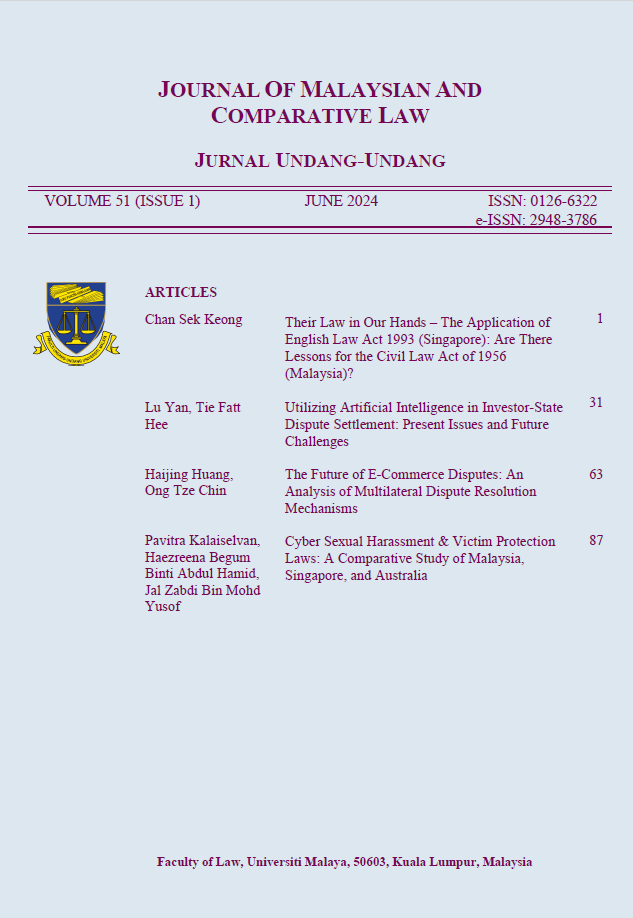
This issue of the JMCL features four articles. In the first article, entitled “Their Law in Our Hands – The Application of English Law Act 1993 (Singapore): Are There Lessons for the Civil Law Act of 1956 (Malaysia)?”, the author explores how English law, once imposed on Penang, Malacca, and Singapore during British colonisation, evolved into the foundation of local legal systems. Justice Keong is convinced that though England lost its territorial empire, it retained a legal empire through the enduring influence of English common law, especially in global finance and trade. In territories lacking unified legal frameworks, English law became essential, and over time, local courts gradually took ownership of it. This culminated in Singapore’s 1994 legal reforms, when it fully broke from Privy Council precedent, signalling the maturation of an independent legal system shaped by national needs and values.
The second article, "Utilizing Artificial Intelligence in Investor-State Dispute Settlement: Present Issues and Future Challenges", considers the integration of Artificial Intelligence (AI) into Investor-State Dispute Settlement, as AI applications have been reshaping the landscape of international arbitration, offering the promise of greater efficiency, objectivity, and analytical precision. The authors also reiterated that though AI has the potential to streamline complex proceedings, enhance evidence evaluation, and support more accurate risk assessments and outcome predictions, this technological advancement also raises critical concerns that warrant careful scrutiny. Issues such as algorithmic bias, ethical dilemmas in automated decision-making, and the risk of diminishing human judgment underscore the need for a cautious and balanced approach. They propose a regulatory framework grounded in transparency, accountability, and periodic algorithmic audits, and argue that AI should serve as a complementary tool, rather than a replacement for human decision-making, particularly in nuanced and sensitive disputes. Additionally, by fostering a collaborative dynamic between human expertise and machine intelligence, they advocate for a future in which AI enhances, rather than undermines, the fairness and integrity of investor-state arbitration.
The third paper, “The Future of E-Commerce Disputes: An Analysis of Multilateral Dispute Resolution Mechanisms”, highlights that the rise of globalisation and the rapid expansion of e-commerce have intensified the need for effective dispute resolution mechanisms within multilateral trade agreements. The paper has attempted to make a comparative qualitative analysis of the dispute settlement systems in the World Trade Organization, the Association of Southeast Asian Nations, and the Regional Comprehensive Economic Partnership. It highlights both the regulatory approaches to electronic commerce and the limitations of these frameworks, and examines the legal structures governing e-commerce disputes across the three agreements to identify the most effective model for addressing such issues in the Asian region. The authors found that while these agreements provide a foundational framework for digital trade governance, they fall short in offering comprehensive mechanisms for resolving e-commerce disputes. As Member States grapple with the inadequacy of traditional systems in addressing the unique challenges of digital trade, the adoption of an Online Dispute Resolution mechanism, which emerges as a viable and forward-looking solution, presents a scalable, efficient, and accessible approach, essential for supporting the continued growth and stability of e-commerce in the region.
The fourth paper, “Cyber Sexual Harassment & Victim Protection Laws: A Comparative Study of Malaysia, Singapore, and Australia”, examines the legal framework of cyber sexual harassment in the context of Malaysia, Singapore, and Australia, as this remains a pervasive issue globally due to the borderless nature of the internet. It affects individuals across all genders and age groups, where perpetrators can harass victims remotely and often anonymously, without any physical presence. This paper critically analyses Malaysia’s current sexual harassment laws to identify their shortcomings. To offer insights for legal reform, the study undertakes a comparative analysis of cyber sexual harassment laws in Singapore and Australia.
Associate Prof. Dr. Mohammad Ershadul Karim
NAVIGATION
Artificial Intelligence Policy
Ethics and Malpractice Statements
MEMBER OF
SUPPORTED SOCIETIES
SUPPORTED CONFERENCE
VISITORS