Behavioral and Neuronal Alterations Following Oral Naphthalene Exposure in Rats
DOI:
https://doi.org/10.22452/mjs.vol44sp1.13Keywords:
Napthalene, toxicity, neuronal alteration, behavioral alteration, neurotoxicityAbstract
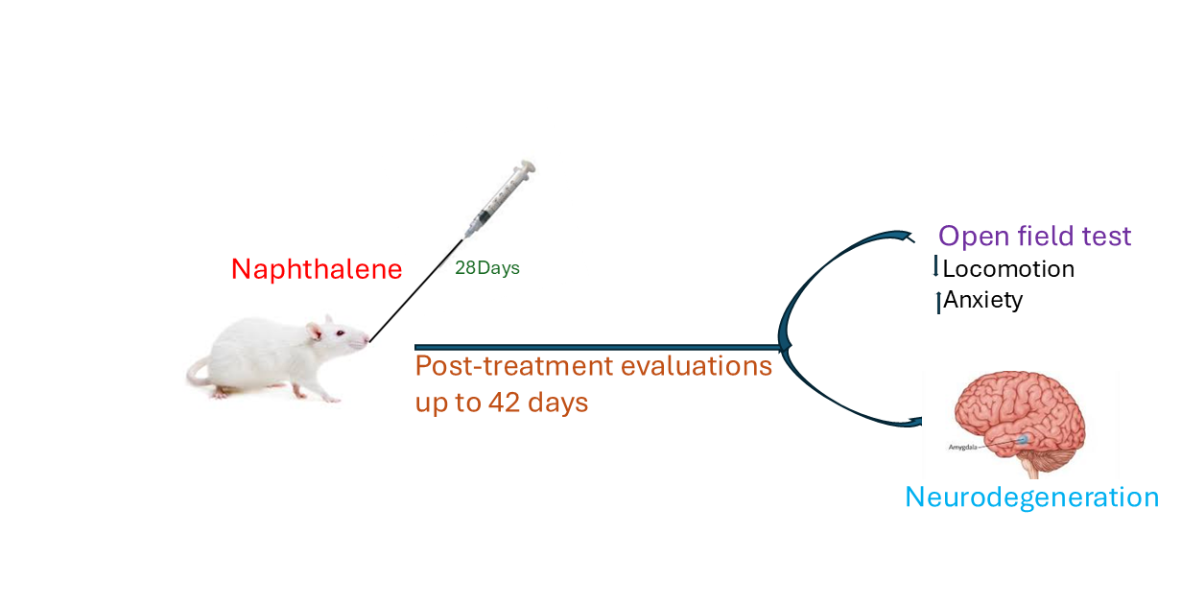
Naphthalene (NP), a widely used polycyclic aromatic hydrocarbon, is present in various commercial products and environmental pollutants. Despite its established toxicity, its impact on neuronal integrity and behavior remains relatively underexplored. This study investigates oral NP-induced behavioral and neuronal alterations in Sprague Dawley rats. Twenty-five animals were divided into five groups and oral NP was administered at varying doses (200 mg/kg and 400 mg/kg) for 28 days, with post-treatment evaluations up to 42 days. Behavioral assessments using the open field test revealed initial hyperactivity, followed by a progressive decline in locomotion and increased anxiety-related behavior in high-dose groups. Cresyl violet staining of the basolateral amygdala showed significant neurodegeneration, with pyramidal neuronal damage more pronounced in high-dose groups. Statistical analysis was conducted using one-way ANOVA, and post-hoc Duncan's test was applied to confirm a dose-dependent decrease in neuronal viability (p < 0.05). Post-treatment observations indicated partial behavioral recovery but no significant reversal of neuronal damage. The findings suggest that oral NP exposure induces anxiety-associated behavioral changes and neurotoxicity in the amygdala, potentially affecting emotional regulation. Further investigation is required to assess the long-term effects of oral NP exposure on brain function.
References
Angu Bala Ganesh, K. S. V., Soman, S., Reginald, S. R., Yamunadevi, A., & Yadav, O. P. (2024). Ultrastructural Changes of Synapses in the Hippocampus of Sprague Dawley Rat Brain following Exposure to Naphthalene Balls. Journal of pharmacy & bioallied sciences, 16(Suppl 2), S1522–S1525.
Anwar, F., Afzal, S., Rasheed, T., & Jan, A. (2021). Naphthalene derivatives: Pharmacological profile and potential therapeutic agents. European Journal of Medicinal Chemistry, 215, 113258. https://doi.org/10.1016/j.ejmech.2021.113258
Baker, R. J., White, M. C., Jordan, T. B., Jolly, L. A., & Truong, T. (2011). Toxicity of naphthalene and its metabolites in human airway epithelial cells. Toxicology and Applied Pharmacology, 254(3), 277–283. https://doi.org/10.1016/j.taap.2011.05.015
Bölükbaş, F. F., Kuloğlu, F., & Oztürk, M. A. (2021). Naphthalene-induced hemolysis and kernicterus in a G6PD-deficient neonate: A case report and literature review. Turkish Journal of Pediatrics, 63(1), 136–139. https://doi.org/10.24953/turkjped.2021.01.020
CDC (Centers for Disease Control and Prevention). (2005). Toxicological Profile for Naphthalene. Agency for Toxic Substances and Disease Registry (ATSDR).
Chocyk, A., et al. (2013b). Stress and the development of adolescent brain: Role of corticosteroids in shaping the adolescent prefrontal cortex. Frontiers in Cellular Neuroscience, 7, 135.
Choleris, E., Thomas, A. W., Kavaliers, M., & Prato, F. S. (2001). A detailed ethological analysis of the mouse open field test. Neuroscience & Biobehavioral Reviews, 25(3), 235–260.
Etkin, A., Klemenhagen, K. C., Dudman, J. T., Rogan, M. T., Hen, R., Kandel, E. R., & Hirsch, J. (2004). Individual differences in trait anxiety predict the response of the basolateral amygdala to unconsciously processed fearful faces. Neuron, 44(6), 1043–1055.
Gupta, R., Talwar, D., & Srivastava, L. M. (1979). Neurological manifestations following acute naphthalene poisoning. Postgraduate Medical Journal, 55(647), 783–785.
Jin, Y., Cheng, X., & Liu, J. (2019). Residual levels of polychlorinated naphthalenes in food and potential health risk. Science of The Total Environment, 689, 1097–1103. https://doi.org/10.1016/j.scitotenv.2019.06.415
Jing, Y., Liu, Y., Zhang, X., et al. (2020). Toxic mechanisms of naphthalene and its metabolites in biological systems. Chemosphere, 245, 125586. https://doi.org/10.1016/j.chemosphere.2019.125586
Koca, N., & Doğan, M. (2022). Severe hemolysis and multi-organ dysfunction following naphthalene ingestion in a child with G6PD deficiency: A case report and review of the literature. Turkish Archives of Pediatrics, 57(1), 107–110.
Krabbe, S., Gründemann, J., & Lüthi, A. (2018). Amygdala inhibitory circuits regulate associative fear conditioning. Nature Neuroscience, 21(6), 898–906.
KSV Angu Bala Ganesh, Payal Panda, Amit H Makwana, Prarthana Kalerammana Gopalakrishna, Kandula Prameela Rani, Thirupathirao Vishnumukkala. (2024). Unraveling the amygdala: A review of its anatomy and functions. Bioinformation 20(11): 1588-1592.
Li, W., Wang, Y., & Li, X. (2021). Occurrence and distribution of chlorinated naphthalenes in human adipose tissues and serum samples. Environmental Research, 194, 110681. https://doi.org/10.1016/j.envres.2020.110681
Lin, C. Y., Hsu, H. T., Lee, H. L., & Yu, C. H. (2015). Naphthalene-induced respiratory toxicity and epithelial injury in mice: The role of Clara cells. Toxicology Letters, 232(2), 398–406. https://doi.org/10.1016/j.toxlet.2014.11.022
Lupien, S. J., McEwen, B. S., Gunnar, M. R., & Heim, C. (2018). Effects of stress throughout the lifespan on the brain, behaviour and cognition. Nature Reviews Neuroscience, 10(6), 434–445.
Mineur, Y. S., Belzung, C., & Crusio, W. E. (2006). Effects of unpredictable chronic mild stress on anxiety and depression-like behavior in mice. Behavioural Brain Research, 175(1), 43–50.
Monroy, E., Hernández-Torres, E., Flores, G. (2010). Dendritic morphology of pyramidal neurons in prefrontal cortex and hippocampus after stress. Brain Research, 1353, 21–30.
Moriceau, S., Roth, T. L., & Sullivan, R. M. (2006). Rodent model of infant attachment learning and stress. Developmental Psychobiology, 48(3), 235–245.
Mugweru, J. W., D’Souza, M. J., & Pratap, S. (2020). Naphthalene exposure routes, toxicology, and mitigation strategies: A review. Toxicology and Applied Pharmacology, 396, 114970. https://doi.org/10.1016/j.taap.2020.114970
Muhammad, A., Kolb, B., & Pellis, S. M. (2011). Stress and prefrontal cortex: Roles in the development of anxiety behavior. Brain Research, 1373, 100–109.
Pannu, R., & Singla, S. (2020). An overview on environmental contamination and toxicity of naphthalene: A focus on health hazards. Environmental Science and Pollution Research, 27(23), 29092–29110. https://doi.org/10.1007/s11356-020-09314-5
Preuss, R., Angerer, J., & Drexler, H. (2003). Naphthalene—an environmental and occupational toxicant. International Archives of Occupational and Environmental Health, 76(8), 556–576. https://doi.org/10.1007/s00420-003-0450-1
Ramos, A., & Mormède, P. (1998). Stress and emotionality: A multidimensional and genetic approach. Neuroscience & Biobehavioral Reviews, 22(1), 33–57.
Shaikh, S., Patel, S., & Brahmbhatt, K. (2023). Naphthalene poisoning: A rare cause of hemolytic anemia and neurological manifestations. International Journal of Medical Toxicology, 19(2), 124–129.
Sharma, R., Mehta, K., & Varma, A. (2024). Mothball (naphthalene) poisoning in adults: A case series and review of neurotoxic outcomes. Medical Journal of Dr. D.Y. Patil Vidyapeeth, 17(2), 124–128.
Spampanato, J., Polepalli, J., & Sah, P. (2011). Interneurons in the basolateral amygdala. Neuropharmacology, 60(5), 765–773.
Sugimoto, T., et al. (1990). Naphthalene-induced changes in rat brain: Histopathological and ultrastructural study. Acta Neuropathologica, 80(4), 349–355.
Świercz, R., & Stępnik, M. (2011). Histopathological evaluation of naphthalene-induced hepatotoxicity in rats. Roczniki Państwowego Zakładu Higieny, 62(3), 247–253. PMID: 21913474.
Valaes, T., Doxiadis, S. A., & Fessas, P. (1963). Acute hemolysis and kernicterus in glucose-6-phosphate dehydrogenase-deficient newborn infants after naphthalene inhalation. Lancet, 1(7280), 1–4.
Waheed, A., Malik, R. N., & Zahid, M. (2020). Human exposure to polychlorinated naphthalenes through breast milk: A review of current trends. Environmental Science and Pollution Research, 27, 11527–11541. https://doi.org/10.1007/s11356-020-07836-5
Waidyanatha, S., Valentine, R., & Johnson, C. (2020). Metabolic fate and distribution of naphthalene and its metabolites in rodent models following multiple routes of exposure. Toxicological Sciences, 174(1), 83–93. https://doi.org/10.1093/toxsci/kfz210
Wang, J., Hu, Y., Wu, Y., Zhang, W., & Gong, Z. (2020). Sources, environmental levels, and human exposure to naphthalene: A review. Science of The Total Environment, 743, 140444. https://doi.org/10.1016/j.scitotenv.2020.140444
Zhang, F., Li, L., Guo, Q., Duan, L., Wang, C., & Liu, Y. (2016). Evaluation of the toxicological effects of naphthalene inhalation in Sprague-Dawley rats. Regulatory Toxicology and Pharmacology, 77, 132–139. https://doi.org/10.1016/j.yrtph.2016.03.002
Zimcikova, E., Slamberova, R., & Svojtkova, M. (2017). Anxiety-like behavior in open field test in rats: Influence of perinatal drug exposure. Physiology Research, 66(Suppl 4), S547–S554.
Downloads
Published
Issue
Section
License
Copyright (c) 2025 Malaysian Journal of Science

This work is licensed under a Creative Commons Attribution-NonCommercial 4.0 International License.
Transfer of Copyrights
- In the event of publication of the manuscript entitled [INSERT MANUSCRIPT TITLE AND REF NO.] in the Malaysian Journal of Science, I hereby transfer copyrights of the manuscript title, abstract and contents to the Malaysian Journal of Science and the Faculty of Science, University of Malaya (as the publisher) for the full legal term of copyright and any renewals thereof throughout the world in any format, and any media for communication.
Conditions of Publication
- I hereby state that this manuscript to be published is an original work, unpublished in any form prior and I have obtained the necessary permission for the reproduction (or am the owner) of any images, illustrations, tables, charts, figures, maps, photographs and other visual materials of whom the copyrights is owned by a third party.
- This manuscript contains no statements that are contradictory to the relevant local and international laws or that infringes on the rights of others.
- I agree to indemnify the Malaysian Journal of Science and the Faculty of Science, University of Malaya (as the publisher) in the event of any claims that arise in regards to the above conditions and assume full liability on the published manuscript.
Reviewer’s Responsibilities
- Reviewers must treat the manuscripts received for reviewing process as confidential. It must not be shown or discussed with others without the authorization from the editor of MJS.
- Reviewers assigned must not have conflicts of interest with respect to the original work, the authors of the article or the research funding.
- Reviewers should judge or evaluate the manuscripts objective as possible. The feedback from the reviewers should be express clearly with supporting arguments.
- If the assigned reviewer considers themselves not able to complete the review of the manuscript, they must communicate with the editor, so that the manuscript could be sent to another suitable reviewer.
Copyright: Rights of the Author(s)
- Effective 2007, it will become the policy of the Malaysian Journal of Science (published by the Faculty of Science, University of Malaya) to obtain copyrights of all manuscripts published. This is to facilitate:
- Protection against copyright infringement of the manuscript through copyright breaches or piracy.
- Timely handling of reproduction requests from authorized third parties that are addressed directly to the Faculty of Science, University of Malaya.
- As the author, you may publish the fore-mentioned manuscript, whole or any part thereof, provided acknowledgement regarding copyright notice and reference to first publication in the Malaysian Journal of Science and Faculty of Science, University of Malaya (as the publishers) are given. You may produce copies of your manuscript, whole or any part thereof, for teaching purposes or to be provided, on individual basis, to fellow researchers.
- You may include the fore-mentioned manuscript, whole or any part thereof, electronically on a secure network at your affiliated institution, provided acknowledgement regarding copyright notice and reference to first publication in the Malaysian Journal of Science and Faculty of Science, University of Malaya (as the publishers) are given.
- You may include the fore-mentioned manuscript, whole or any part thereof, on the World Wide Web, provided acknowledgement regarding copyright notice and reference to first publication in the Malaysian Journal of Science and Faculty of Science, University of Malaya (as the publishers) are given.
- In the event that your manuscript, whole or any part thereof, has been requested to be reproduced, for any purpose or in any form approved by the Malaysian Journal of Science and Faculty of Science, University of Malaya (as the publishers), you will be informed. It is requested that any changes to your contact details (especially e-mail addresses) are made known.
Copyright: Role and responsibility of the Author(s)
- In the event of the manuscript to be published in the Malaysian Journal of Science contains materials copyrighted to others prior, it is the responsibility of current author(s) to obtain written permission from the copyright owner or owners.
- This written permission should be submitted with the proof-copy of the manuscript to be published in the Malaysian Journal of Science
Licensing Policy
Malaysian Journal of Science is an open-access journal that follows the Creative Commons Attribution-Non-commercial 4.0 International License (CC BY-NC 4.0)
CC BY – NC 4.0: Under this licence, the reusers to distribute, remix, alter, and build upon the content in any media or format for non-commercial purposes only, as long as proper acknowledgement is given to the authors of the original work. Please take the time to read the whole licence agreement (https://creativecommons.org/licenses/by-nc/4.0/legalcode ).